The Calabrian Sayings Corner: "You can scrub and wash all you want, a beautiful woman must be beautiful by nature!"
A saying that celebrates authentic and spontaneous beauty, the kind that needs no artifice to shine.
L'Angolo dei Detti Calabresi — A’ vogghjia mi lu fai lu strica e llava la beddha av’essari ‘i natura!
# The Calabrian Sayings Corner: Beauty Cannot be 'Scrubbed and Washed' In!
Welcome back, friends of Calabria Dreamin', to our corner dedicated to popular wisdom that smells of sun, sea, and a touch of irony. Today we dive into a proverb that, with a sly smile, reminds us of a universal truth, especially when it comes to... well, beauty!
Today's Saying: "A’ vogghjia mi lu fai lu strica e llava la beddha av’essari ‘i natura!"
Literal translation
Meaning
Cultural note
The Festival of Natural Beauty in Rocca di Vento
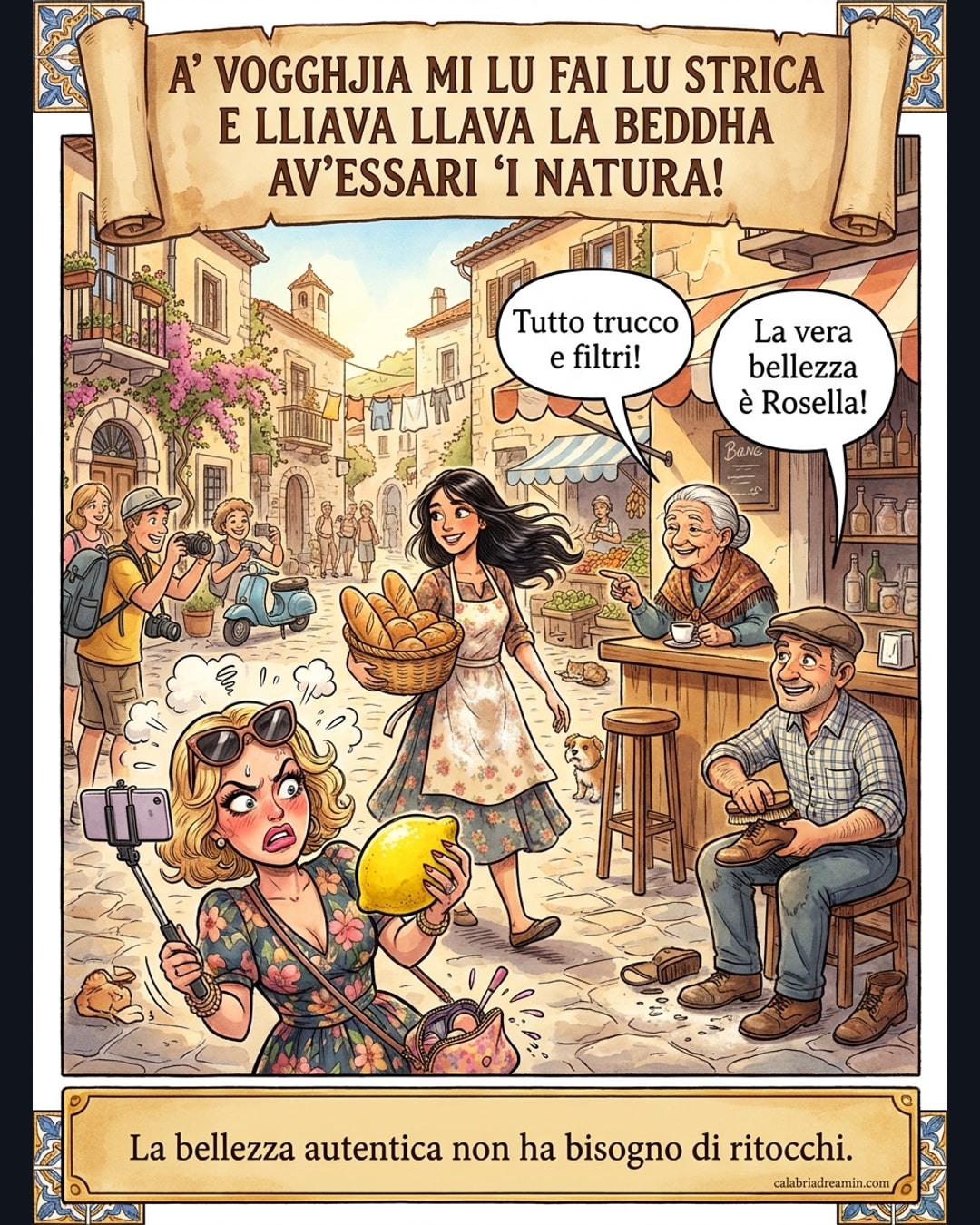
Imagine a summer afternoon in Rocca di Vento, a Calabrian village where time flows slowly like the melody of an accordion. The piazza is the beating heart of the town, and today it's livelier than usual. There's a festive atmosphere, and not just for the upcoming chili pepper festival, but because news that the famous Milanese influencer, Chiara Glam, is visiting to "discover authentic roots" is stirring spirits.
At the table of Bar Centrale, Nonna Carmela, with her sharp eyes and a headscarf, sips a bitter coffee. Next to her, Compadre Peppe, the village shoemaker, is diligently polishing shoes with almost mystical dedication.
"Have you seen, Peppe? That Miss Glam," Nonna Carmela exclaims, nodding towards Chiara, who is posing with a gigantic lemon for a selfie, "all makeup and hair! She looks like a work of art, but one that gets ruined in the rain!"
Peppe, without looking up from his shoe, replies with a sly smile: "Nonna, it's her job! She has to appear 'perfect' for the social media world!"
At that moment, Rosella, the baker's daughter, emerges from the alley, her hair disheveled by the wind, her face flushed from the heat of the oven, and an apron stained with flour. She has a spontaneous smile and eyes that shine with a light all her own, as she carries a basket of fresh bread. A group of German tourists, sitting at another table, watch her with admiration, taking photos, clearly struck by her genuine Mediterranean beauty.
Nonna Carmela turns to Peppe, whose eyes are now fixed on Rosella, and gives him a light nudge. "See, Peppe? A’ vogghjia mi lu fai lu strica e llava la beddha av’essari ‘i natura!" she says with a tone that allows no argument. "That Chiara Glam might be an 'influencer', but Rosella is an 'influencer' by nature! She doesn't need filters to make her soul shine!"
Peppe nods thoughtfully, then, with a twinkle in his eye, adds: "You're right, Nonna! And besides, the smell of Rosella's bread is much more 'authentic' than any brand-name perfume!"
Laughter echoes in the piazza, while Chiara Glam, oblivious to the lesson in popular wisdom, searches for the perfect angle for her next post, perhaps unaware that true perfection, sometimes, needs no angle, but merely to be.
Deep Roots and Sincere Beauty
This Calabrian proverb is an ode to authentic beauty, the kind that doesn't hide behind masks or artifices. In peasant cultures, where life was hard and genuineness a value, what was true, solid, and intrinsically good was appreciated. Beauty was seen as a reflection of the soul and health, not as a mere ornament. It's a reminder to look beyond appearances and value the essence.
And you, friends of Calabria Dreamin', what do you think? Do you believe beauty is a gift of nature or a work of art that can be "scrubbed and washed" at will?