The Calabrian Sayings Corner: When Day and Night Make Peace!
Discover the Calabrian proverb revealing February's balance: “A frevaru notti e jiornu vannu paru!”. A journey through popular wisdom, village square laughter, and the deep roots of a transitional month.
L'Angolo dei Detti Calabresi — A frevaru notti e jiornu vannu paru!
The Calabrian Sayings Corner: When Day and Night Make Peace!
Welcome, Calabria dreamers and lovers of popular wisdom! Today we dive into the heart of February, a month that here, between biting cold and the first timid rays of sunshine, has its own special proverb. Get ready to discover the charm of "A frevaru notti e jiornu vannu paru!".
Today's Proverb: "A frevaru notti e jiornu vannu paru!"
Literal word-for-word translation into English: "A": In / At "frevaru": February "notti": night "e": and "jiornu": day "vannu": go * "paru": equal / even
Literal translation: "In February night and day go equal."
Real meaning and everyday popular use in Calabria: The proverb "A frevaru notti e jiornu vannu paru!" expresses popular wisdom linked to the observation of natural cycles. Its real meaning is that in February, the duration of day and night tends to equalize, marking a point of balance in the transition from winter to spring. It is an indication of the progressive lengthening of the days after the winter solstice, a sign that the darkest and coldest period is about to end and that light is gaining ground. In everyday popular use in Calabria, this saying is used to emphasize the inevitability of change and the balance that nature, despite its variations, tends to re-establish.
A Balance... Almost Perfect!
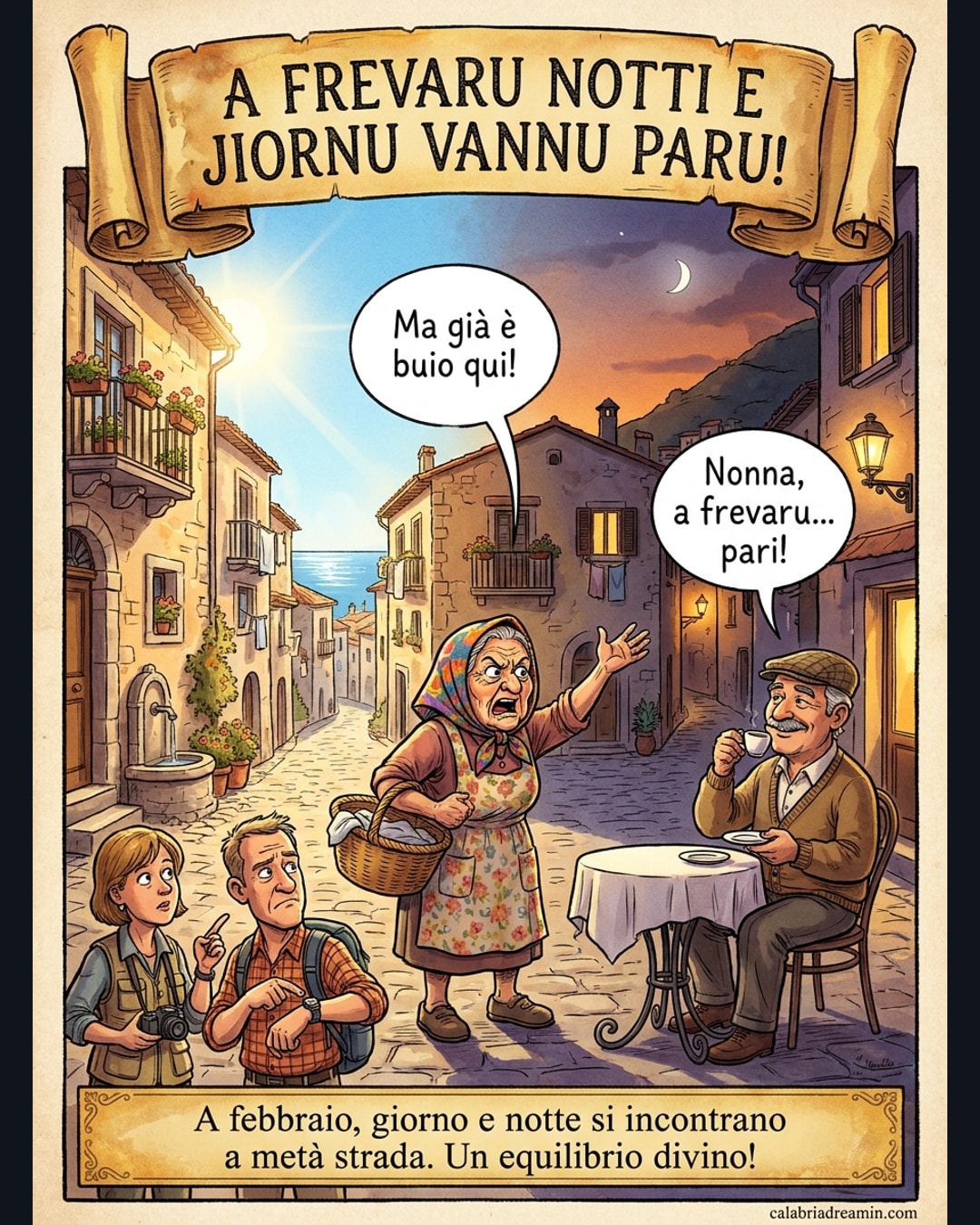
Imagine a sunny piazza in a Calabrian village, not too crowded, but vibrant with life. It's a Wednesday in February, the air is crisp but the sun promises good things. At a table at "Bar da Ciccio", Compare Totò is sipping his macchiato coffee, glasses perched on the tip of his nose as he reads the newspaper. A little further on, Nonna Concetta, with a colorful headscarf keeping her unruly curls in check, is hanging laundry. Nonna Concetta is a force of nature, with an opinion on everything, especially the weather.
"But look at this sun, Totò!" she exclaims, waving an embroidered sheet. "It looks like it wants to burst, but then the cold bites your bones! And in the evening, zap! It's already dark! You can't get anything done!"
Compare Totò, who has the patience of a monk but the irony of a cabaret artist, lowers his newspaper. "Nonna Concetta, why are you complaining? The days are getting longer! Soon it will be spring, and goodbye wool sweaters!"
Nonna Concetta looks at him with an raised eyebrow, as if Totò had just said the most obvious and wrong thing in the world. "Yes, Totò, yes! But you forget the saying! A frevaru notti e jiornu vannu paru! It's not like summer has arrived, eh! It's a balance, you understand? The night doesn't give in, the day doesn't triumph. They stand there, looking at each other, like two old friends playing cards and neither wants to lose!"
At the next table, two German tourists, Greta and Hans, who are trying to decipher the bar menu, stopped to listen, intrigued by the lively discussion. Greta, who speaks a little Italian, turns to Totò with a smile. "Excuse me, sir... 'paru'? What does it mean?"
Totò, proud to be a cultural ambassador, adjusts his glasses. "It means 'equal', miss! Even! Nonna is saying that in February, day and night take turns almost equally. It's like a truce between the darkness of winter and the light of spring that's coming. A balance, you understand?"
Hans nods, enlightened. "Ah, like the equinox, but earlier!"
Nonna Concetta, who never misses an opportunity for a life lesson, interjects with a little voice that allows no argument: "Exactly, young man! Nature teaches us patience! You can't have everything at once. First, night and day make peace, then the good season arrives. It's like when you cook parmigiana: each layer has its time, otherwise it won't be good!"
Totò shakes his head, amused. "And you, nonna, are the perfect parmigiana of wisdom!"
Nonna Concetta smiles, pleased. "And you, Totò, you are 'u basilico! You always fit well!"
The piazza echoes with laughter, while Greta and Hans, with a new Calabrian proverb in their hearts and a smile on their faces, finally order two "caffè, per favore!". A small moment of Calabrian life, where ancient wisdom mixes with daily humor, and even the weather becomes the protagonist of a comedy.
The Deep Roots of Time
This saying, so simple yet so evocative, has its roots in the millennial observation of natural cycles, knowledge passed down from generation to generation. As we saw in our research, "frevaru" takes us back to Latin purification rites, an idea of renewal that perfectly matches the balance between light and darkness. "Jiornu" and "paru" remind us of the richness of our dialect, capable of transforming Latin into everyday poetry. It is a proverb that invites us to reflect on the harmony of nature, its rhythms, and how even in moments of transition there is beauty to be found.
And you, friends of Calabria Dreamin', do you already feel the air of spring or are you still balanced between night and day? Tell us your February proverbs!