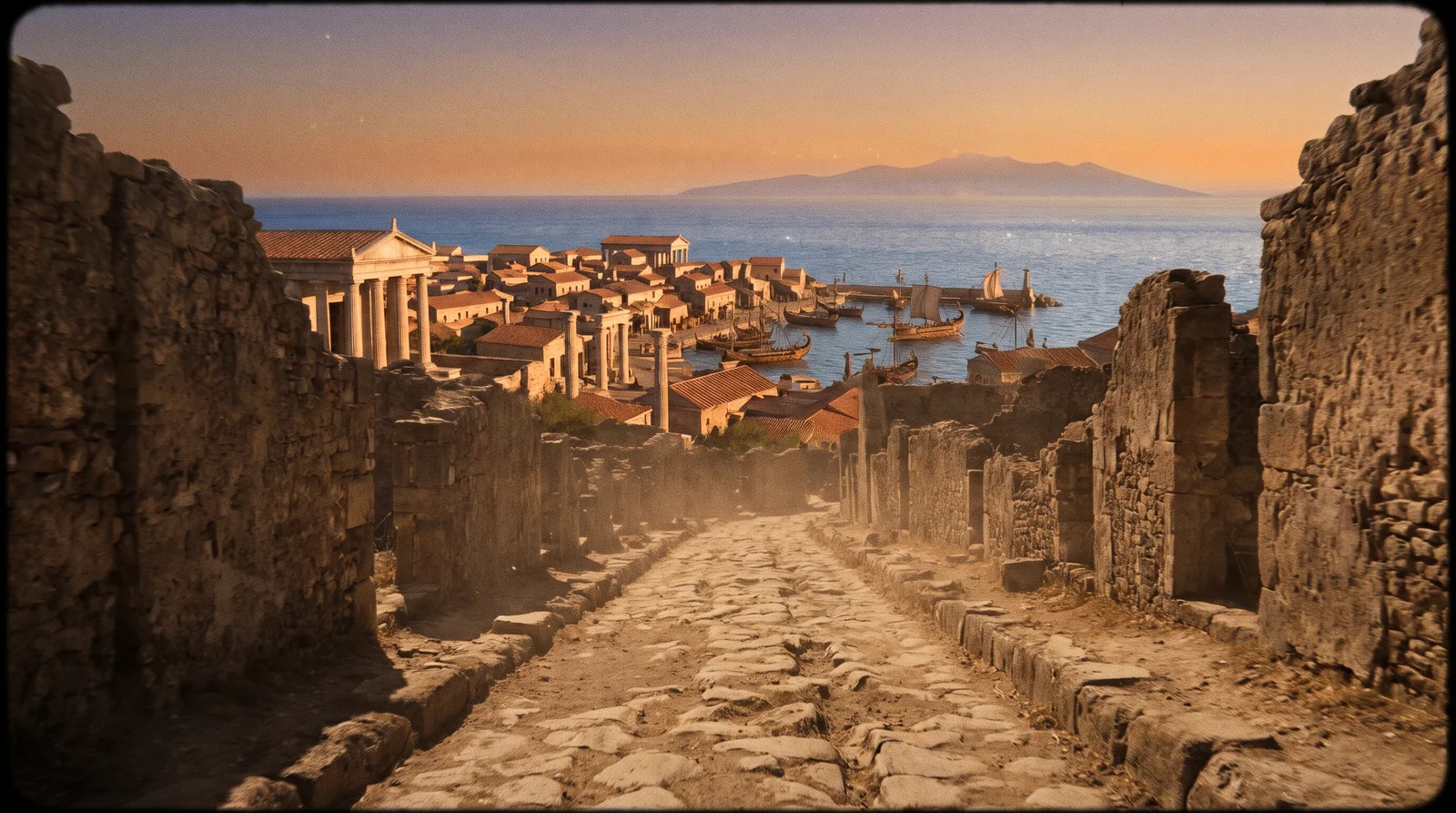
About Paul of Tarsus: From Reghium to Tauriana Through the Eyes of Lucillo
The passage of Paul of Tarsus through ancient Reghium and along the coast of Tauriana in May 61 AD, narrated by Giuseppe Spinelli (CSEAAM Calabria) in «Vallis Salinarum – U caminu i San Fantinu» through the eyes of Lucillo.
Lucillo of Tauriana on his way to Reghium
Article originally published in print in «Vallis Salinarum – U caminu i San Fantinu», a historical-religious itinerary project and eponymous volume published by Domenico Bagalà in collaboration with MiBAC in 2018, dedicated to the rediscovery of the Byzantine and rock-cut heritage of the Plain of Gioia Tauro.
My name is not important; I am an Italiote but they call me Lucillo. I am a villager from the land of Tauriana. The beautiful Roman city, once land of the Bruttii, which rises by the sea and where sailors gladly stop before facing the monsters that lurk ad fretum where the waters of the two seas mingle. I have come to Reghium to exchange the fruits of my farm—oil, olives, and fruit—for what I need.
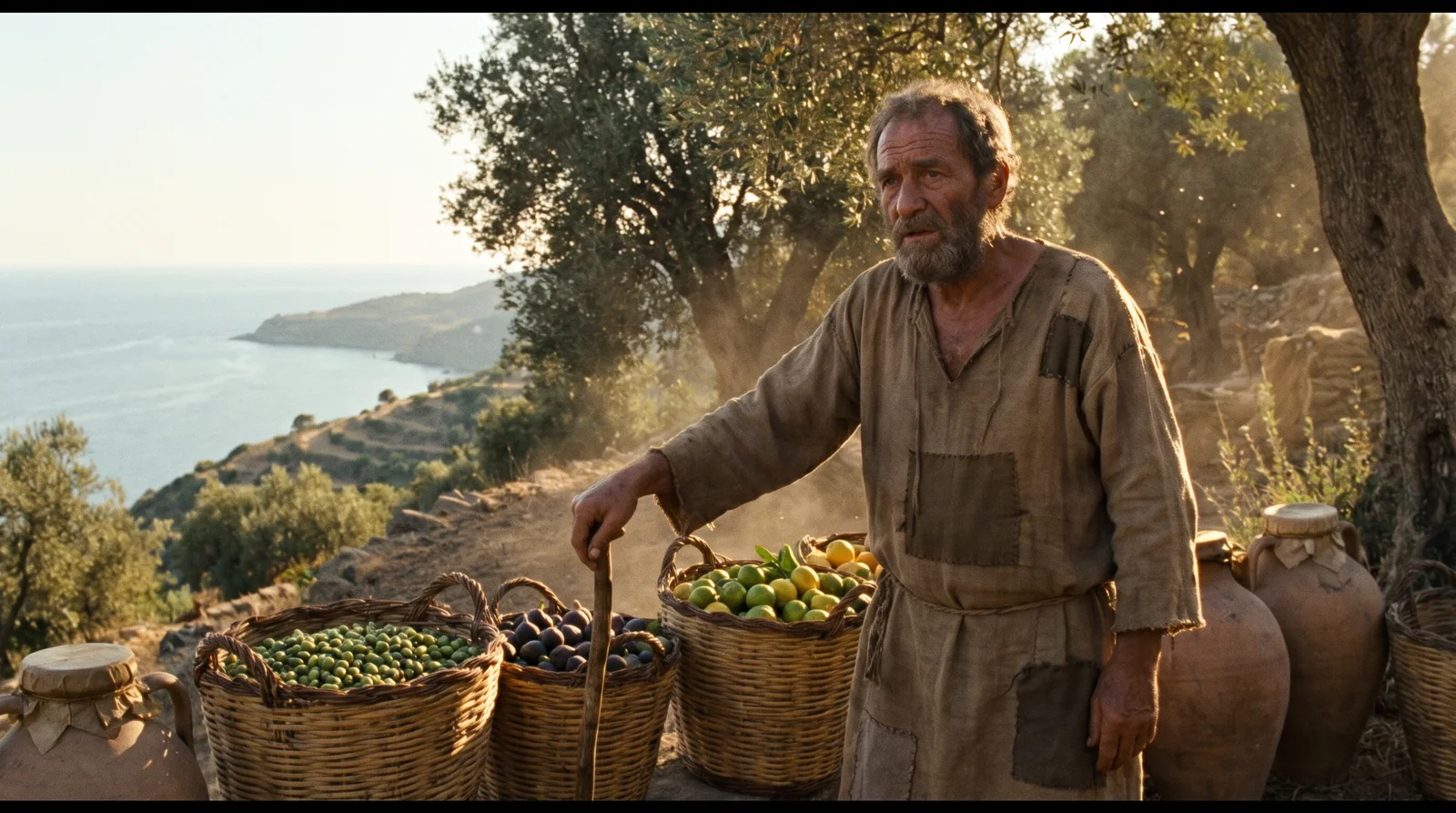
Lucillo among the olive trees of Tauriana with amphorae of oil, olives, and fruit ready for trade at the port of Reghium.
A Jewish Prisoner at the Port of Reghium
I am intrigued by a man who asks to speak during the ceremony in honor of Diana Fascelis. He is a Jew and claims to be a witness to the greatness of a new, unique Divinity. He speaks Greek, and although he asserts he is a Roman citizen, he doesn't speak Latin at all. He says his name is Paul of Tarsus. In truth, we don't know who he is. A centurion keeps a close eye on him. The suspicion immediately arises that he is a prisoner. He is a stocky man, rather short, with bowed legs. He handles words well. It's clear he has a vast knowledge of philosophical and religious texts. His background seems secular to me, even though he defines himself as a repentant Pharisee. He is almost bald and has a large grizzled beard. What is most striking is his face, endowed with an enormous snub nose. Ugly like Socrates and dark-skinned.
He says he fell, struck by a luminous vision, while on his way to Damascus: a calling and his choice of inner maturation. Almost thirty years have passed since those events, and he remembers them as if they happened yesterday. He presented himself as an envoy, an apostle, for the Gentiles. Who gave him this authority is unknown. I think he is accustomed to being respected. He has charisma; he seems energetic and harsh, like the character of his speech, which is not amiable; he argues to be right, and everyone is impatient to get rid of him. Paul of Tarsus, as he called himself, seems to know nothing of nature. He never spoke of it throughout his monologue. When he arrived, he didn't look around; he only quickly ascended the temple steps. He certainly didn't know horses well; of this, from his account, I am sure. Or perhaps he was seized by an attack of the sacred disease and wanted to hide it? It is known that the body is invaded by evil spirits. So why does he come to tell it? Falling before everyone on the road to Damascus must have been hard. There are no evil spirits, but Christ himself, sublime. He had become blind and in Damascus regained his sight.
We do not know if he ever had time to observe anything else around him, preoccupied as he was, first persecuting and then defending the new order of things triggered by a rebellious and partisan Nazarene. We believe not. After all, he was merely a learned advocate of words, a scrupulous and formal observer of the Law, who became an envoy, an eleventh-hour apostle.
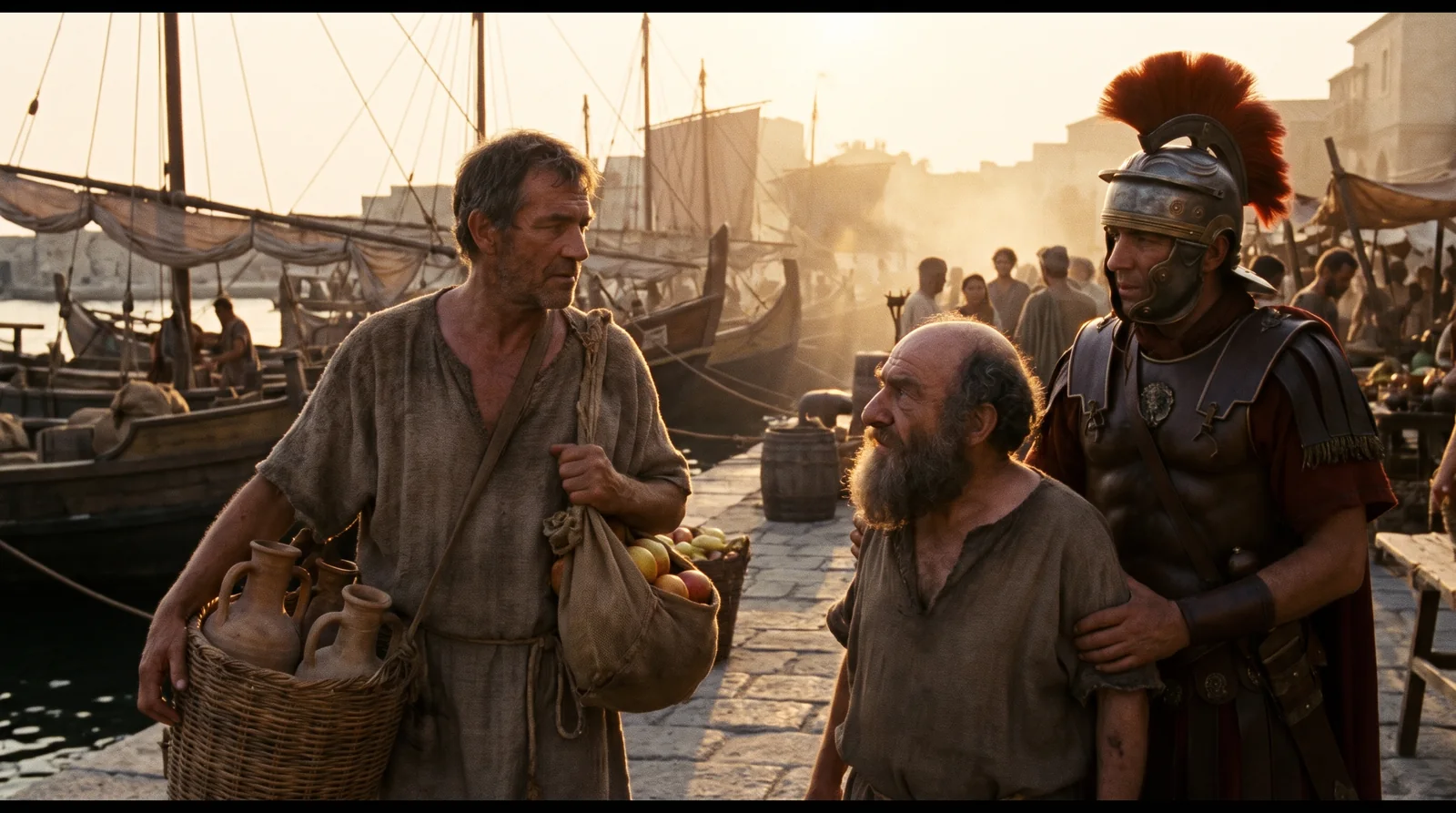
The encounter at the port of Reghium: Lucillo observes Paul of Tarsus closely escorted by the Roman centurion.
From Malta to Reggio in May 61 AD: The Temple of Diana Fascelis
On his sea voyage, he, of Jewish culture and Roman citizenship, being taken to Rome to be judged by the emperor, had the good fortune to dock in Malta after the ship he was on had escaped a storm never seen before. I was in Malta in my youth: enchanted landscapes, hospitable people, good food, and many other things that did not interest Paul. He preached and made converts, these are rumors from the ship; after three months of solitude and encounters, often in excavated caves, he sailed on the same cargo vessel and made landfall in Syracuse and Reggio. In the month of May of the year 61 after the birth of Christ, which in Greek means: the Anointed.
In Regio, Paul, the crew, and soldiers remained for only one day, just to catch their breath and await favorable tides. We do not have much other firsthand information, but certainly, our ancestors were astonished by his audacity in interfering with the sacred ceremonies dedicated to Diana Fascelis.
He, Paul, a captive, spoke within earshot of the centurion who was responsible for that group of prisoners. Prisoners who enjoyed a certain freedom. Only the rowers, bound to their oars, had remained on board with a few guards and whispered among themselves the news of a God who did not love slavery. The seed sown by Paul was germinating. The boat had reached the first Greek city on the strait, likely with the approaching night: there was a great festival, and maidens danced around the temple with lit torches. One could barely see the palms and roses that adorned the temple in garlands, as was the custom. Instead, the forms of the dancers were more visible, which we can imagine seemed reprehensible to Paul. It does not surprise me to consider us pagans tolerant, allowing a Jewish prisoner, even if a Roman citizen, to discourse on the importance of a Male God, organizer of all living and non-living things, to elevate the dignity of human status. We Greeks, Romans, and other listeners had perfectly understood the concept. The divinity had become man for the well-being of humanity. There had been precedents: Jupiter had abducted Europa, Mars had seduced Rhea Silvia, and Pluto had taken Proserpina from Demeter's maternal love. Even the divine Apollo had a story with a mortal, Pythaïs, from whom Pythagoras was born. But it is only a legend that we hand down in the land of the Bruttii, just to remain within the area of Greek and Roman myth.
The pagan temple of the virgin Diana opened to the sea breeze; it was located at the mouth of the most important river in the area, which protected the city, a melting pot of different cultures, to the south. That small triangle that jutted out towards nearby Sicily was called Calamizzi (beautiful reeds, as the Greek migrants exiled from their motherland Euboea had christened it). The setting sun tinged the goddess's tall statue pink, with one foot on a crescent moon and a bow in her hand. The shadows grew long.
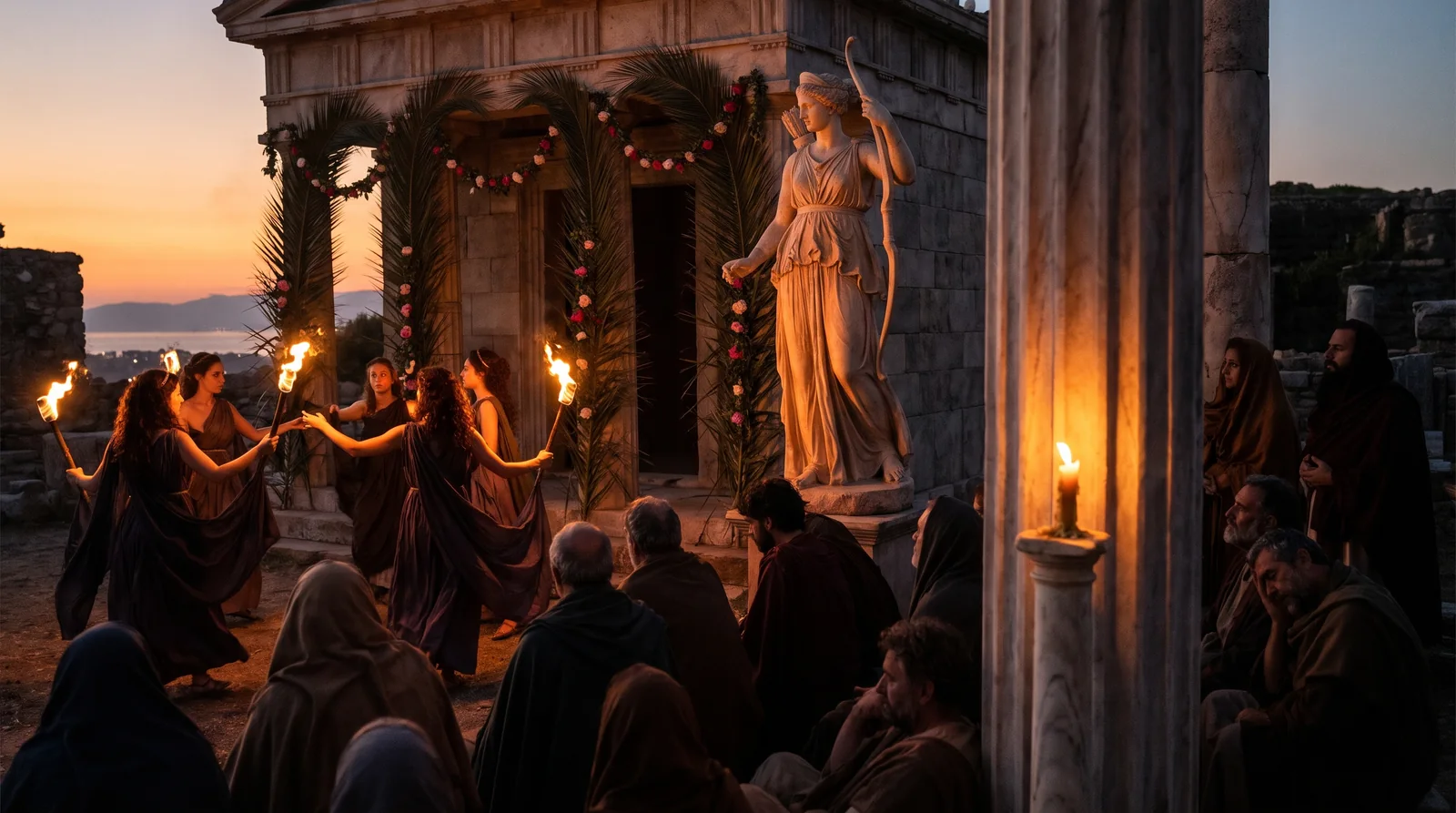
Maiden with lit torches during the nocturnal ceremony in front of the Temple of Diana Fascelis in Calamizzi.
The Burning Column, the Flora of Reghium, and the Naturalistic Gaze
What did Paul see around him, apart from the bewildered faces of those who listened? I repeat, little. A faint candle barely illuminated the night. Paul spoke at length, without inserting an allegorical passage to nature into his flowing discourse, which, perhaps, he would only have noticed the next day. Paul understood scriptures and knew how to present words; the spirit hovered, and nature remained, as always, an insignificant jewel of divine goodness. He began in the evening and continued speaking all night. At night, words have vaguer shadows, almost unnoticeable. They flowed well even among inattentive and somewhat sleepy people. Exploiting the miraculous candle stub he had been granted, which had caught fire to the entire marble column on which it had been placed, he spoke.
The weather was what it was; a hot and sticky sirocco wind had blown. I looked around from a naturalistic perspective; I had read papyri with the writings of Titus Livius and Pliny the Elder. What Paul had not noticed on the somewhat chipped walls of the buildings and the temple, I had seen: wallflowers (Cheiranthus cheiri), capers (Capparis spinosa), pellitory (Parietaria officinalis), and, certainly, lesser navelwort (Umbilicus horizontalis) stood out. Some nettles (Urtica dioica), on the other hand, colonized the urinal spaces that favored the dark corners of the buildings. Paul did not even notice, the next day, that along the streets, at the base of the high sidewalks, a few sparse groups of ruderal plants eked out a living, because as soon as he disembarked, he was re-embarked. I imagine in a great hurry. Diana's priests had certainly mentioned the matter to the centurion. The Romans had let him speak out of curiosity: their Aristotelian philosophy held that truth was concealed in debate. Indeed, that debate was synonymous with truth. Paul had a different vision; he sought a truth he had already possessed and proposed it as the only possible one. This already seems to me an evident contrast between two different ways of thinking.
The next day, at dawn, aboard the ship, it is uncertain whether Paul noticed that around the city stretched a mantle of woods descending from the slopes of what they called Aspromonte, the white mountain. Vines (Vitis vinifera) embracing twisted fig trees (Ficus carica), as the Oracle of Delphi had predicted, stopped where the colors of the gardens beyond the Calopinace took over, bordered by common reeds (Phragmites australis), giant reeds (Arundo donax), oleanders (Nerium oleander), and chaste tree or monk's pepper (Vitex agnus-castus), whose ground seeds were mixed with food to make chaste those who had offered their carnal desires to the gods. The entire ensemble, the near and distant panorama, was called by the Greeks «beautiful picture». Calopinace, precisely. In the distance, the mountain, Aetna, the industrious seat of the god Vulcan, smoked, reminding the Greeks and, perhaps, also the Romans, of distant Olympus. The mountain, tall, to the right of those looking from Euboea and the Chalcidice peninsula, the one with three fingers projected into the Aegean Sea. Of animals, only a numerous flotilla of yellow-legged gulls (Larus michahellis) vied for the fish discarded by fishermen. Their clamorous screeching was no small matter.
I presume they fed him chickpeas, lentils, and fava beans seasoned with cold-pressed olive oil (the famous green oil) and not the inferior oil given to slaves. All served with wild onions on a plate of spelt or wheat bread. As a Roman citizen, he would have been entitled to a piece of meat and a tankard of Greek spiced wine, which was fashionable in Regio at the time. He would have eaten fish flavored with Garum, a sauce with a vague fishy taste of obscure Hispanic origins, much loved by the Romans. No other dietary, visual, or biological distractions, which, however, had affected the sailors and soldiers. Paul was all of a piece, even if not yet a Saint. Perhaps he cast his gaze around without seeing. Yet, one was faced with a variety of invasive plants: some sparse grasses, at the edge of the temple square, like wall barley (Hordeum murinum) and Bermuda grass (Cynodon dactylon); a splash of color from a group of red common poppies (Papaver rhoeas) or some sky-blue and timid love-in-a-mist (Nigella damascena). Perhaps he thought, like many: look how many weeds, and wasn't overly impressed. In reality, we don't know. He left no writings to that effect. We cannot, however, say that he was a lover of nature and agriculture like Him whose cause he championed. When he spoke, he did indeed call a spade a spade, but to make himself understood, he did not use easy concepts illustrated by herbs and animals, as was rumored to be common in the parables of that Nazarene. Often, those who listened to him had to ask for clarification on what he was talking about.
Yet, many immediately became Christians, so it is said, with a formula to define, a posteriori, those who adhered to the new words that were not yet in use. I had perceived a widespread murmur at his words. We pagans were annoyed by the intolerance he displayed and soon understood that it was not dialectic but religious propaganda. We tried to make him stop. He, however, heedless, continued, even questioning the divine figure of our Emperor Nero. We turned to the centurion, but the myth was already beginning to spread: the fire burned, the candle finished, consuming the hard Greek marble stone. No one could extinguish that flame that the priests had impudently allowed Paul to place on a column with good reason. The entire column burned, transformed into a monstrous and gigantic candle.
So we endured him out of genuine fear, until the centurion finally intervened and took him away. Those who embraced the new thought waited for a long time for a letter from him, as was said to have happened for several other cities. Not even a greeting card or token of consideration was found written by Paul for the city that had welcomed him, the first peninsular Roman city on his journey to Rome. I fear he did not hold the inhabitants of our ancient city in high regard, or perhaps? Or perhaps it is seen that Paul considered them secure and upright, with God-fearing women and probably not quarrelsome, envious, jealous, and deceitful. The numerous Jewish community of Regio had arrived with its priests at the sound of the news that a Jew was speaking and was astonished by his words. They were very displeased that the Romans called those who listened to him 'Jews,' lumping everyone together. Paul spoke with them in a language I did not understand, Aramaic someone whispered; on the other hand, Paul had been clear: everything was said to the glory of the Lord and in the hope of a renewal of Israel. But they did not believe him. Many others breathed a sigh of relief when he finally re-embarked, dragged by the centurion who had a devil for every hair on his helmet, as was evident.
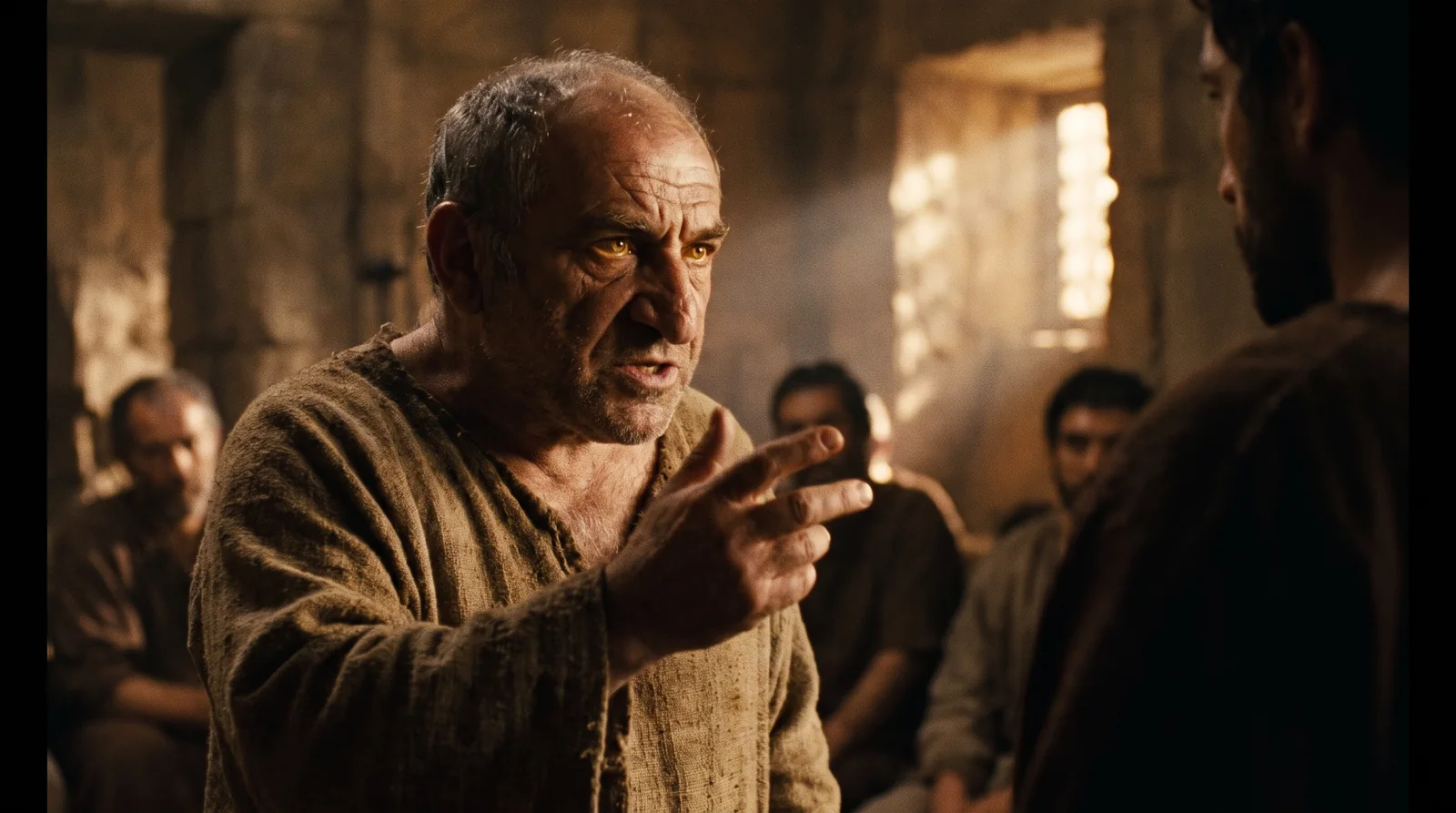
The harsh and charismatic speech of Paul of Tarsus before the listeners in the warm light of the port.
The Route Between Scylla, Charybdis, and the Flowery Cliffs of the Costa Viola
The rising current's movement was awaited to facilitate passage towards the open sea. In May, the ship's captain sailed propelled by a light southerly wind, the libeccio, past the Costa Viola where the colors of the sea and land merged. He had breathed a sigh of relief. Everything seemed beautiful after having passed unharmed between the ravenous mouths of the two monsters guarding the strait: Scylla and Charybdis. Paul remained impassive, not even a superstitious charm, as he had never believed in those legends: that fact which terrified sailors was certainly a phenomenon related to the tides dominated by the will of God. It was clear and evident that he sufficiently pondered that seafaring fear.
Yet the coasts were rich in coves with ravines and caves, high above the ship. Near the shore, there was always the danger of some surfacing rock. The sea shifted from deep intense blue to soft azure and iridescent turquoise, becoming a pale green near the sandy seabeds. They had given me a passage to the beach of Tauriana where they would disembark me. I was a witness to events that would not be repeated.
Here, on the cliffs high above the waves, common broom (Spartium junceum) colored in dark yellow patches as far as the sea spray had traced its boundaries, interspersed with delicate flowers like small bluish-violet patches of rosemary (Rosmarinus officinalis) and the faint pink of rockroses (Cistus incanus), amidst the persistent resinous scent of pine trees (Pinus pinea) immersed among the twisted branches of tree spurge (Euphorbia dendroides) adorned with yellow cyathia. All that colorful green ended against a continuous curtain of dark holm oaks (Quercus ilex), reddish cork oaks (Quercus suber), and silvery wild olive trees (Olea europaea). What beauty to see the coast from the sea. I had never seen it before.
Paul, however, continued to be uninterested in this lush floral nature. Yet always a gift from his Creator. It was the period when Proserpina was once again among us for a short while: asphodels (Asphodelus albus) were beginning to fade. He looked at those wonders without any emotion. He was distracted by thoughts that no one understood. Between Scylla and the promontory on which Tauriana stood, the coast had receded, and the waves began to give him a slight sense of nausea. The horizon was glimpsed with the circle of sister islands of Hephaestus' forge, which took their name from the father of the winds, Aeolus.
Anyone who had mentioned the lush flora of those areas was immediately silenced by the uninterested Paul. Flora was an ancestral deity to be forgotten by neophytes as soon as possible because she was certainly not a patron of life, but of wrongdoing. Desecrating adversaries is an ancient practice. I hypothesize that the spread of the new doctrine in these shores will take its time. And, perhaps, it will have to be imposed.
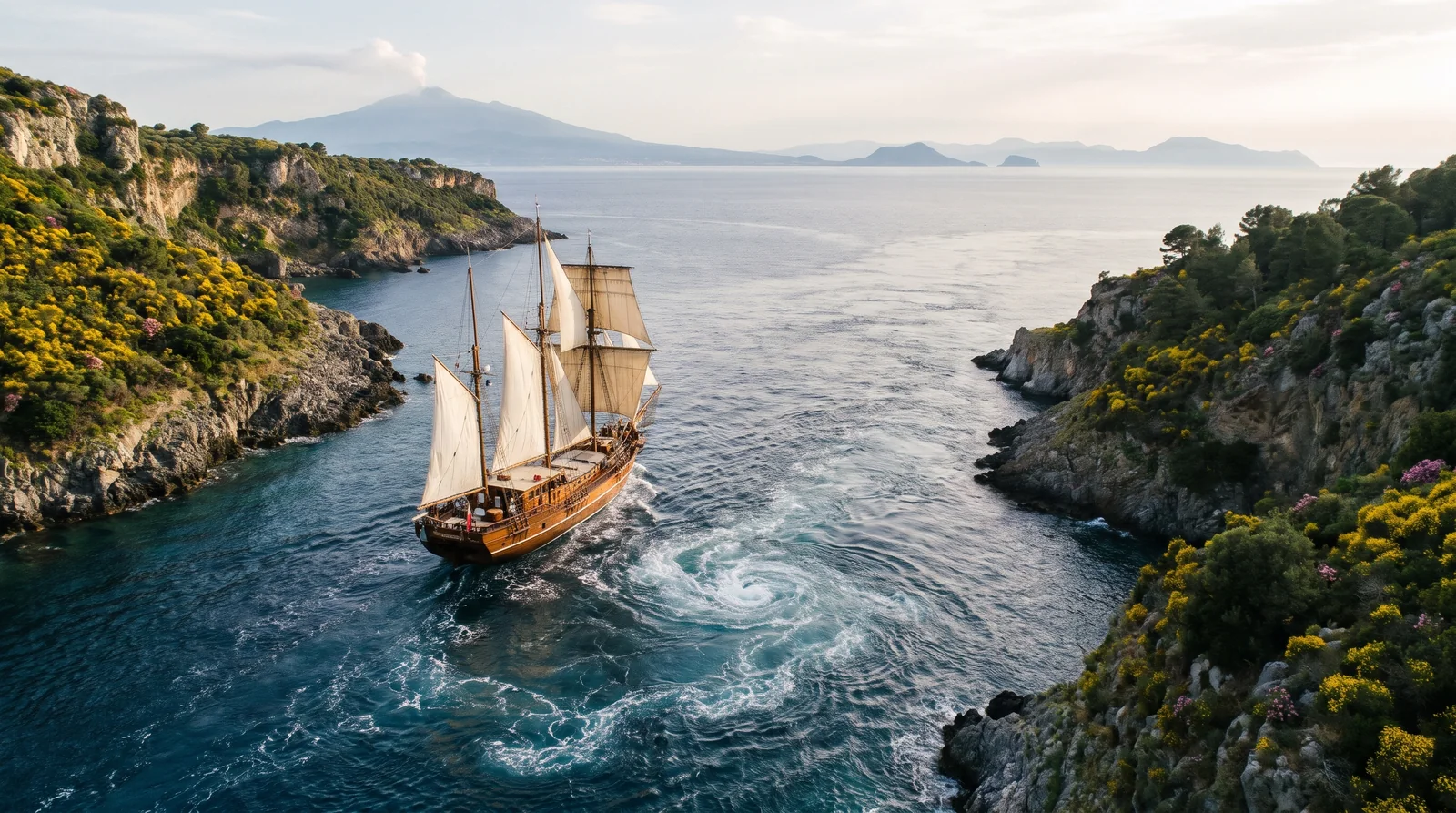
The Alexandrian ship sails propelled by the libeccio wind between the currents of the Strait and the cliffs of the Costa Viola.
Landing at Tauriana, Passo Cavallo, and the Starry Sky
The ship anchored at Tauriana, high on the promontory, and a small boat took me to the white sand beach. The captain, Dux navis, had circumstances allowed, would have preferred to stop here rather than at Reghium, the uniform. Here the sand was fine for the ship's hull, and the port well-equipped. Moreover, by hearsay, the hinterland offered countless pleasures and unexpected delights. He had heard of a Roman estate, a few miles inland, in that locality called ad equus, or Passo Cavallo, not far from the consular road Annia-Popilia. There, even this Paul would have come to his senses and for a moment forgotten his eagerness to preach for the salvation of souls. Something surely had to interest him. Without any complications and without disturbing anyone's sleep.
The Dominus, the owner of the farm, whom I knew, would have welcomed him with the hospitality due to anyone knocking at his door, even letting him taste the ripe fruits of the black mulberry (Morus nigra). Good wine, spelt bread, soft cheese, chestnut honey, sausage with wild fennel, fava beans, and field vegetables in batter, golden-fried in boiling oil. Delicacies.
That Dominus, a lover of life and Flora, would surely have discussed with this irreducible and possessed Pharisee, as his own ancient companions in faith now designated him. Many points converged, however, with the ideas professed by Paul: there were no slaves on his estate, but only free men, and a God of Love, just, protective, and benevolent, was certainly better than the miseries of overly human Deities. A God for all, to whom the different paths of men's choices led. The Dominus, unlike Paul, held women in high regard, offering them equal rights and admiring them unconditionally.
He would have invited him to set aside disputes about deities for a moment and would have led him to see his fields, to breathe a breath of fresh air. He would have shown him flowers of all colors: yellow common rockroses (Helianthemum nummularium), orange field marigolds (Calendula arvensis), violet creeping thistles (Cirsium arvense), red pomegranate flowers (Punica granatum), and green, almost invisible, walnut flowers (Juglans regia). And the white umbels of dwarf elder (Sambucus ebulus), the purplish flowers of borage (Borago officinalis), the sky-blue ones of field forget-me-not (Myosotis arvensis), and the greenish quaking grass (Briza maxima). And the serapias orchids (Serapias vomeracea) with their deep brown-purple tongues hidden in meadows of small pink nodding catchflies (Silene nutans). The fruits of the Hesperides were known, of course: we imported citrons and lemons from the Near East, with a sour taste, acrumen the Latins called them.
There was, however, much to think about and much to reflect upon: why had the Gods ever allowed all this? Perhaps because they were the offspring of an immeasurable need for security, one for every circumstance, in man's image? And could the revelation of a single God, master of good and evil, alleviate man's insecurity? Could the faith of believing in an Entity that interacted with you and guided you exorcise the fear of feeling alone and left to oneself? The idea of solitude is a bad thing, and perhaps a single divinity felt too constricting for man's small heart, even if reason listened to the uniqueness of that newly rediscovered God and to the water rites for purification. It continues to escape me what advantage there might be for us mortals in having a single God instead of many to whom one can turn in every circumstance. But so it is. Life itself dragged man into the fear of darkness and death, and every morning was a rebirth. Thus, the day was for savoring the scents of the earth and rejoicing in the colors of rainbows; the night, however, was the time to look within oneself and, immersed in the starry sky, understand the smallness of man. Perhaps this was the secret of our life.
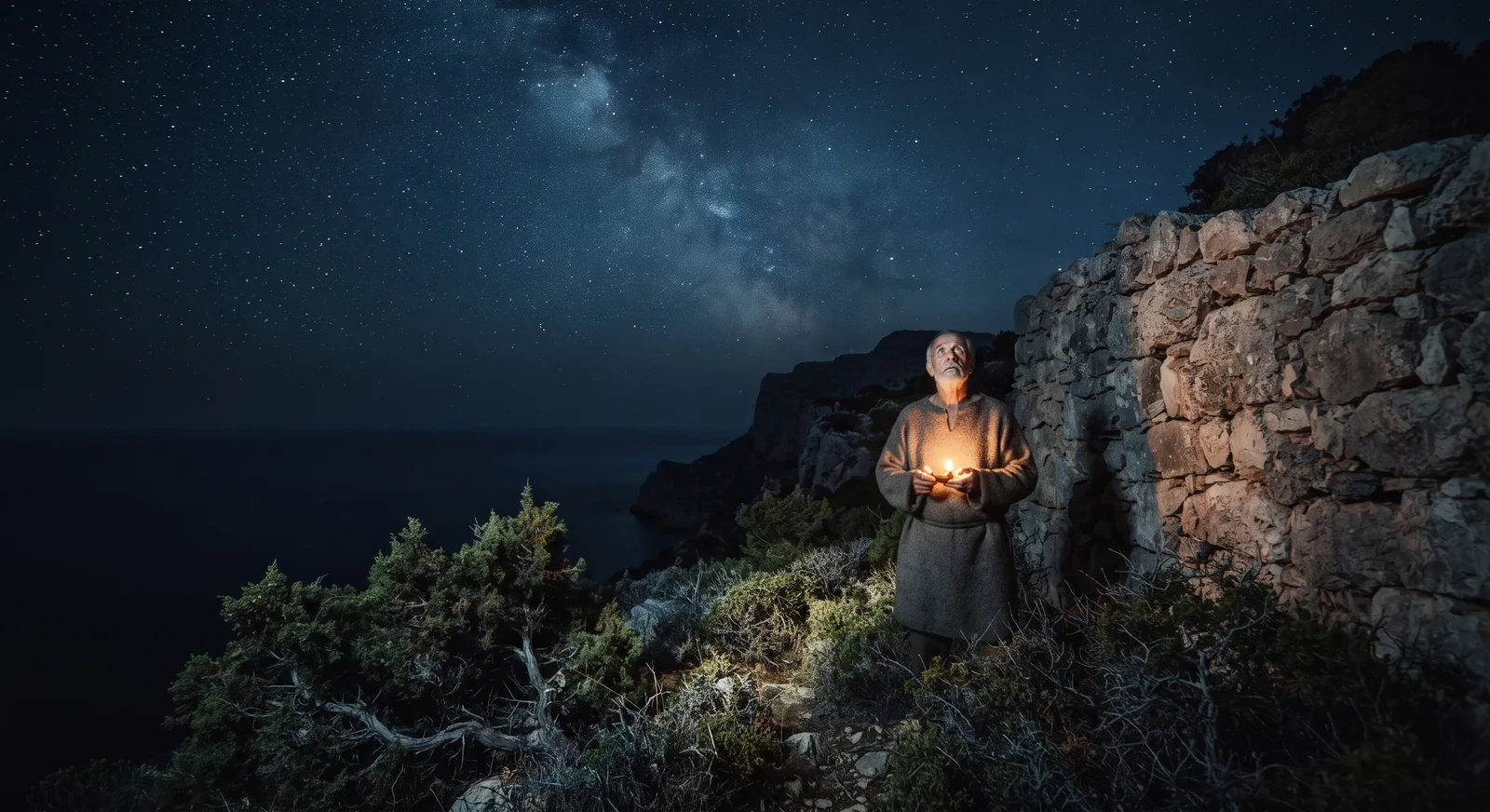
Night on the promontory of Tauriana under the Milky Way: the time to look within oneself and measure the smallness of man.
The Ship Towards Pozzuoli and the First Church of San Fantino in Tauriana
In the air, however, there was already the scent of storm and bloody struggles: those new ideas that had a basis of peace will, given my life experience, be hidden and obscured by man's tendency to accuse the different of impiety. And to preserve the only admitted truth, the mortal body would be purged to benefit the immortal soul.
The Alexandrian boat was already far away and fading from sight, its prow towards Pozzuoli. Entrusted to the wind that grazed the coast, Paul spoke again to the people bustling on the promontory where Tauriana stood. Something in that speech must have struck the inhabitants.
It was they who built a place to gather. Thus was born the first Christian church, which would be dedicated to San Fantino the Elder, whom they called «The Horseman». The event took place long after that extraordinary and unforeseen passage that brought Paul before the emperor's judgment and to his death.
To delve deeper into the archaeological history of these places, you can also read our itinerary onTauriana di Palmi and San Fantinoand discover the guides dedicated toPalmiandReggio Calabria.
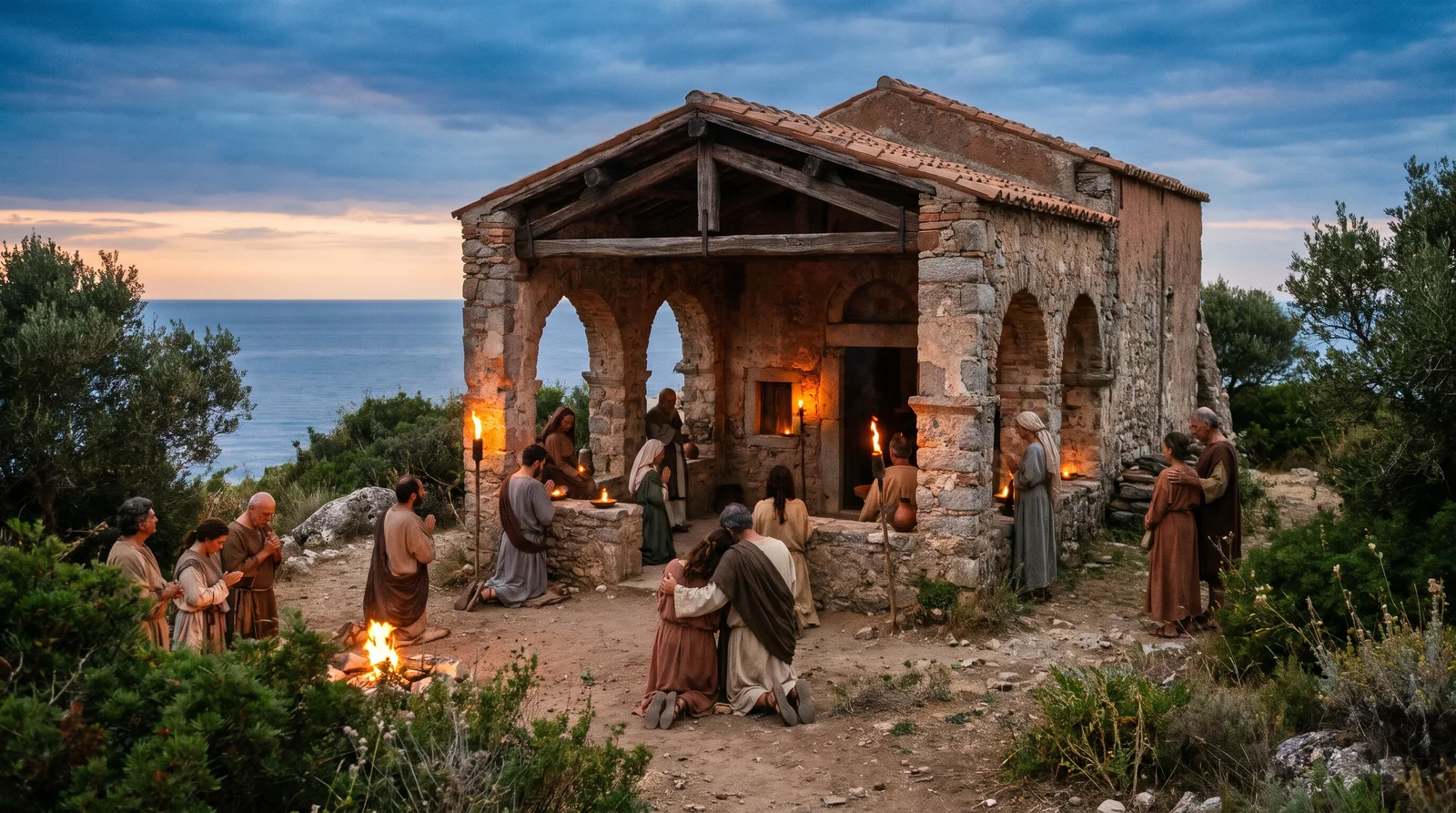
The community gathered in the evening light before the small stone church on the cliff of Tauriana.
About the Author: Giuseppe Spinelli (Giuseppe Spinelli Mayer)
Giuseppe Spinelli (Giuseppe Spinelli Mayer) is an agronomist, writer, and Southern Italy scholar originally from Reggio Calabria, known in particular for his commitment at the helm of CSEAAM-Calabria and for his activities related to environmental education and the enhancement of the Calabrian territory.
- Education: born in Reggio Calabria on December 9, 1942, he obtained his high school diploma from the «Leonardo da Vinci» Scientific Lyceum in Reggio Calabria in 1960 and a degree in Agricultural Sciences from the Catholic University of Piacenza in 1965.
- CSEAAM-Calabria: he served as president of CSEAAM-Calabria, engaging in initiatives and publications related to environmental education in collaboration with the Calabria Region.
- Cultural activities and civic engagement: a Southern Italy historian and author of writings and stories set in the Calabrian territory. In Reggio Calabria, a room at the confiscated asset «La Nave di Teseo» was also dedicated to him.
To learn more about his journey and initiatives related to the territory, you can consult the local news on thededication of the room to Giuseppe Spinelli at Parco Ecolandia, theStrill.it archive on CSEAAM-Calabria and environmental education, and the editorial note onBooksprint Edizioni.
Antonio Magazzù
Food Technologist · Independent Researcher · Founder Studio Anthos Alba
Born in Palmi on the Costa Viola and graduated in Food Science & Technology at the Mediterranea University of Reggio Calabria, Antonio blends historical research, gastronomic heritage, and AI innovation to share authentic Calabria worldwide.
Amazon Author · Creator of the 3D Tauriana Archaeological Tour
Get hidden itineraries, villages & weekend festivals
One curated email per week with new guides, upcoming events, and real Calabrian makers. Zero spam.
By subscribing you accept our Privacy Policy. Unsubscribe anytime.