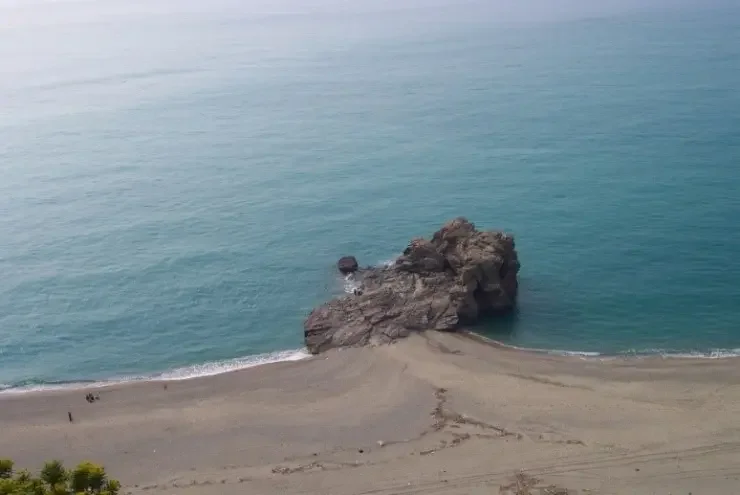
What to See in Calabria: Discovering Tauriana di Palmi and its Saint, Fantino
Discovering Tauriana, one of the largest and most important cities of Magna Graecia, and its Saint, Fantino: millennia of history, archaeological sources, and sacred traditions along the Costa Viola.
Discovering Tauriana and its Saint, Fantino
Throughout its long and ancient history, Tauriana changed its name several times: the Italics called it Taurianum, the Romans Tauriana, and the Byzantines Tavriana / Tavriano; later it became so closely identified with its greatest son that for centuries it was called San Fantino. In the early twentieth century, at the initiative of historian Antonio De Salvo, it reclaimed the ancient name «Taureana», just as «Tauro» was added to Gioia and Iatrinoli and Radicena became «Taurianova».
We know that Tauriana was the mother of many villages in the plain and that in the Roman period its territory became ager publicus and the seat of a Prefectura; it was an episcopal see as early as the 4th century and «capital of the Eparchy of the Saline» (today's Plain of Gioia Tauro). In the Byzantine period its importance was such that one of its bishops, Theodore, signed third — after the Pope and Eastern Empress Irene of Athens — the acts of the Second Ecumenical Council of Nicaea in 787, convened by Pope Adrian I, which condemned iconoclasm and affirmed the legitimacy of sacred images in churches.
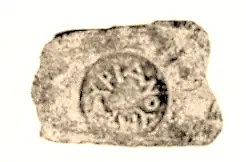
Brick stamp of the Tauriani bearing an inscription in Greek characters (TAYPIANOYM).
The Mystery of the Thesunti Tauriani and the Tabula Peutingeriana
Archaeological research has revealed the historical presence of a mysterious civilization, the «populus of the Tauriani», identifiable in a broader historical-geographical context with the Italic people of the Brettii («the rebels») who inhabited ancient Calabria. The earliest historical mention known to us comes from a passage in Cato's Origines, highlighting its seven rivers:
«The Thesunti Tauriani, he says, take their name from the river that flows nearby. Their city was first held by the Aurunci and then by the Achaeans returning from Troy; their territory is crossed by six rivers and a seventh, called Pecoli. Here it is said that Orestes arrived with Iphigenia and Pylades to atone for the killing of his mother. Until recently a sword could be seen fixed in a tree, left there, it is said, by Orestes» [1].
The presence of the Tauriani south of the Metauros is attested by historical sources around the mid-4th century BC. In the 1st century BC they strategically chose to negotiate annexation to the Roman Empire, allowing Roman soldiers to enter Tauriana peacefully. Thanks to their good relations with Rome, they won political-administrative autonomy and a territory of their own between Rhegion (Reggio) and the lands under the jurisdiction of Lokroi (Locri), which had opened an outlet on the Tyrrhenian Sea by founding Medma (Rosarno).
Note [1]: Thesunti Tauriani vocantur de fluvio, qui propter fluit... (Cato, Origines, Book III).
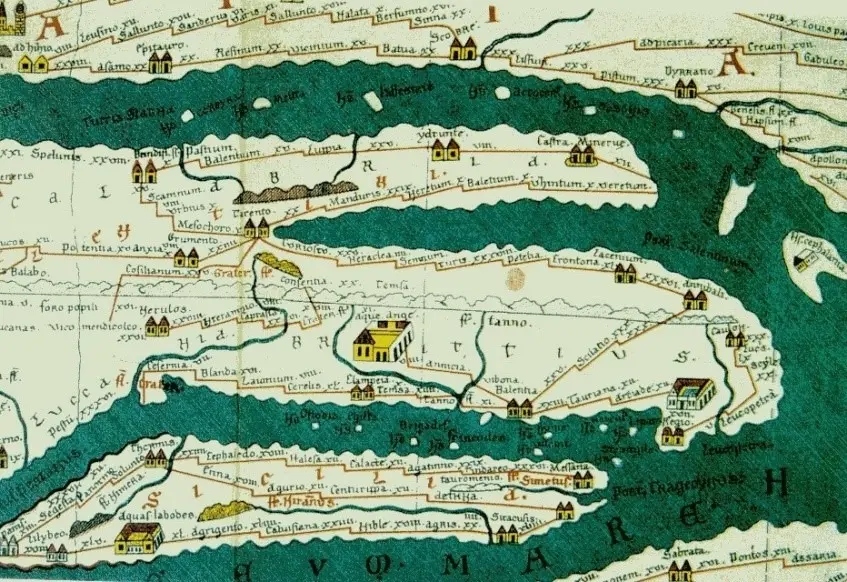
Detail of the Tabula Peutingeriana (medieval copy of an ancient Roman map) showing Tauriana along the Tyrrhenian coast.
Borders, Archaeology, and the Church of San Fantino
On the coast, the northern border between the territories was the river Metauros (Petrace) and to the south the Sfalassà torrent of Bagnara; inland, the border followed the pre-Aspromonte belt where archaeological excavations confirmed the Tauriani presence at Contrada Palazzo, Torre Cillea, and the settlement of Mella in old Oppido, and southward at Serro di Tavola above the Sfalassà torrent in today's Sant'Eufemia d'Aspromonte, where a military outpost stood. In this period the Tauriani clearly abandoned their subordination to Rhegion, even minting their own coinage [2][3]. Due to pockets of resistance, however, the Romans were forced to seize and perhaps destroy another major Taurian city near modern Oppido in Contrada Mella [4].
History records the Tauriani as tall, alert, and active people who fiercely resisted invaders. Their main city, with an important port, was embedded in a major economic and social exchange network, evidenced by large stamped bricks bearing Greek, Latin, and Oscan inscriptions found even in the crypt of San Fantino [4]. Taureana flourished in late antiquity and the early Byzantine age, as shown by excavated ruins [5], funerary inscriptions of the 4th–5th centuries AD, and above all the crypt of San Fantino, the oldest place of Christian worship in Calabria, dedicated to the oldest Calabrian saint.
Its prosperity suffered a severe blow toward the end of the 6th century due to Lombard raids attested in letters of Pope Gregory the Great: Taureana was temporarily abandoned and the population took refuge in the rock settlement of Pignarelle at Palmi.
References: [2] D. Castrizio, Reggio ellenistica, Gangemi, 1995; [3] L. Costamagna, Klearchos 149-156, 1996-1997, pp. 115-134; [4] F. Costabile, Klearchos 69-72, 1976, p. 105; [5] F. Zagari, in Palmi, un territorio riscoperto, ed. R. Agostino, Rubbettino, 2001.
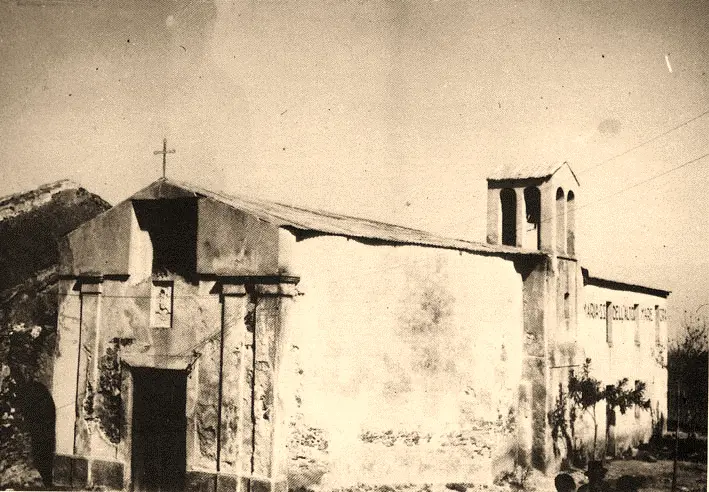
Nineteenth-century church partially rebuilt by Pietro Militano on the ruins of the 1552 church built by Count Pietro Antonio Spinelli.
From Byzantine Splendor to the Norman Charter
The city of Tauriana nevertheless continued to prosper even after Roman decline, reaching its greatest splendor during the Byzantine era.
At the beginning of the second millennium, the Normans transferred the episcopal see from Taureana to Mileto, which shared pastoral care over the entire Saline territory with the bishopric of Oppido.
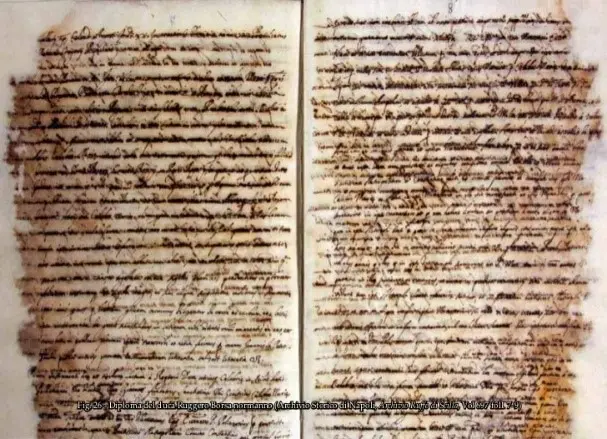
The Norman charter: diploma of Duke Roger Borsa (State Archives of Naples, Ruffo di Scilla Collection, Vol. 697 foll. 7-9).
Origins of the Cult of the Madonna dall'Altomare
Historical reference: 7th century — Taureana, July 24. The episode is historically attested in the oldest hagiographic text of Calabrian literature, written in the 8th century by Bishop Peter of Taureana on the life and miracles of Saint Fantino.
«To complete the narrative, I will add an episode I had almost forgotten. Nearly all the inhabitants of this city speak of it, having heard it from their fathers. It was the very day of the Saint's sacred memorial, when all the local people had gathered as usual for the religious commemoration and the great feast of July 24. Some vessels of those unbelievers [the Agarenes, the customary designation for Saracens] attacked this territory, and one appeared right opposite the temple of the Saint. Suddenly a violent whirlwind churned up the sea.»
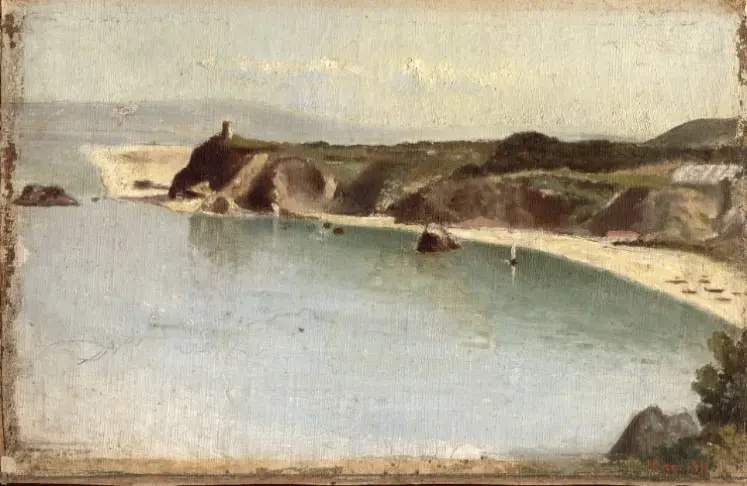
«Gulf of Taureana – the Stones of the Ships», Attilio Zagari, oil on panel, August 18, 1911.
The Rock of the Ships and the Miracle of Saint Fantino
«Driven by the fury of wind and waves, the ship crashed against the rocks and shattered. Of the warriors aboard, some perished in the sea while others were captured alive by the Christians who had rushed to the shore. They told their captors that as they approached, they had seen on the rock a very young man holding a smoking firebrand. Beside him stood a woman dressed in purple. At a sign from the woman, he hurled the firebrand menacingly at the ship, which immediately sank completely. Hearing this account, those celebrating the Saint glorified God, and the captured Agarenes believed, were baptized, became Christians, and never wished to return to their lands.»
Centuries later, the episode remains preserved in local toponymy: the «Scoglio delle Navi» (today Scoglio dell'Isola), site of the apparition of Saint Fantino and the Virgin, was anciently called Πέτραι νῆες (Petre Nees, «Stones of the Ships») and became known in dialect as Petri Niri (Black Stones). Sailors also know «'a sicca i San Fantinu» (Saint Fantino's shoal) a few miles offshore toward the Temple of San Fantino, where the shipwreck miracle (Miracle no. 18 in the bios of Saint Fantino) took place.
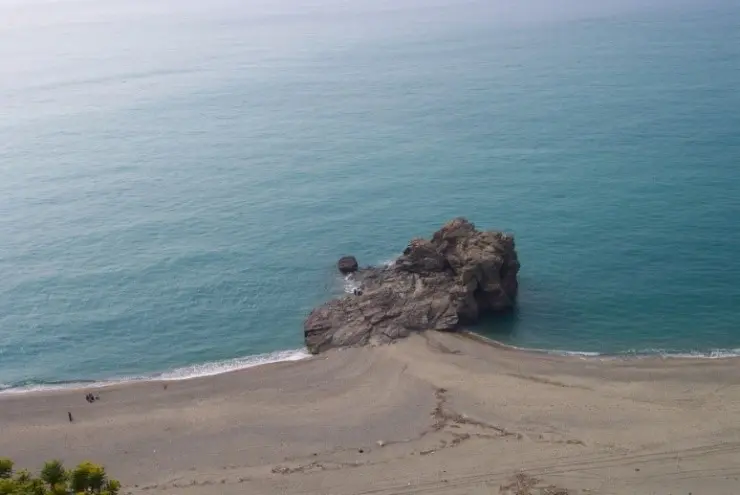
«Scoglio delle Navi» (today Scoglio dell'Isola) in Taureana di Palmi, traditional site of the apparition of Saint Fantino and the Virgin Mary.
The 1552 Painting Commissioned by Count Spinelli
Later, in 1552, Count Pirro (Pietro Antonio) Spinelli of Seminara sought to commemorate this prodigy — handed down from fathers to sons across generations — by rebuilding the church dedicated to Saint Fantino and Maria Santissima dall'Alto Mare and commissioning a painting depicting the Virgin between Saint Fantino and Saint Philip, surrounded by a cycle of Saints.
At the center of the composition appear 16th-century Taureana with its Castle, the «Temple of the Saint», a reliquary of Saint Fantino, a fountain symbolizing life, a well representing the Aghiasma (sacred spring), the sea with a sailing ship symbolizing both peril and progress, and at the bottom the coat of arms of the Spinelli family.
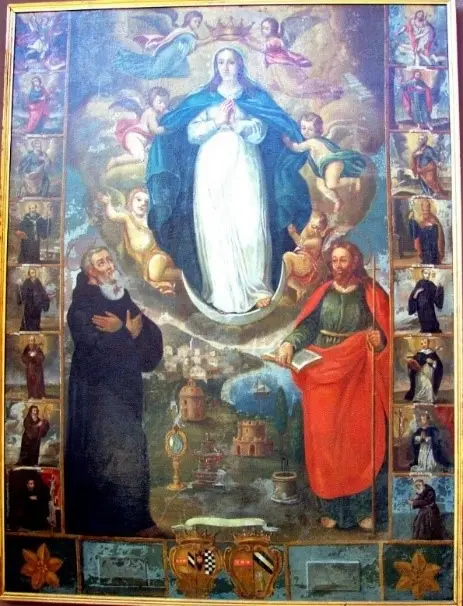
The 1552 painting commissioned by Count Pietro Antonio Spinelli: Our Lady of the High Sea between Saint Fantino and Saint Philip, with 16th-century Taureana below.
The Nineteenth-Century Print from San Biagio dei Librari
In the nineteenth century, the 1552 painting was reproduced as an engraved sketch by the printing house of San Biagio dei Librari in Naples and distributed among the people of Taureana as a devotional print.
The Latin inscription at the bottom reads: «VERA ET ANTIQUA IMAGO S. MARIA AB ALTO MARI D. Fantini Quae magno Populi concursu ac pietate veneratur in ecclesia civitas destructae Taurianensis», attesting to the enduring devotion in the destroyed city of Tauriana.
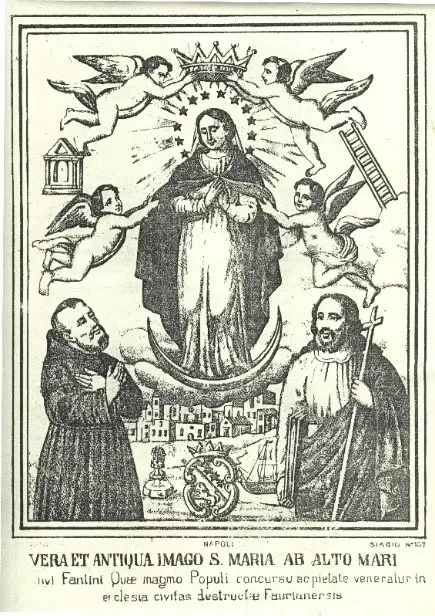
The nineteenth-century devotional print reproduced by the San Biagio dei Librari press in Naples for the faithful of Taureana.
Taureana and Saint Fantino «il Cavallaro»
Taureana is the city of Saint Fantino. His presence so deeply shaped it that both the settlement of Taureana and even the promontory now known as Sant'Elia were once called San Fantino (see the 1490 Venetian «Portolano Rizo»). The Early Christian Crypt of San Fantino is the oldest place of Christian worship in Calabria.
Saint Fantino «il Cavallaro» (the Horseman) tended an open-range horse stud across the surrounding hills and mountains in solitude, punctuated by acts of charity toward poor peasants. His work belongs to a millennia-old tradition attested here and in the neighboring Poro range (ancient Hipponion) from Greek antiquity until the last century, when a company of horsemen still rode from Lubrichi down to Taureana to honor the Saint. Funerary inscriptions tell us who his fellow citizens were, while miracles recorded by Bishop Peter after the ancient practice of incubatio — sleeping beside the venerated tomb — confirm the antiquity of his cult.
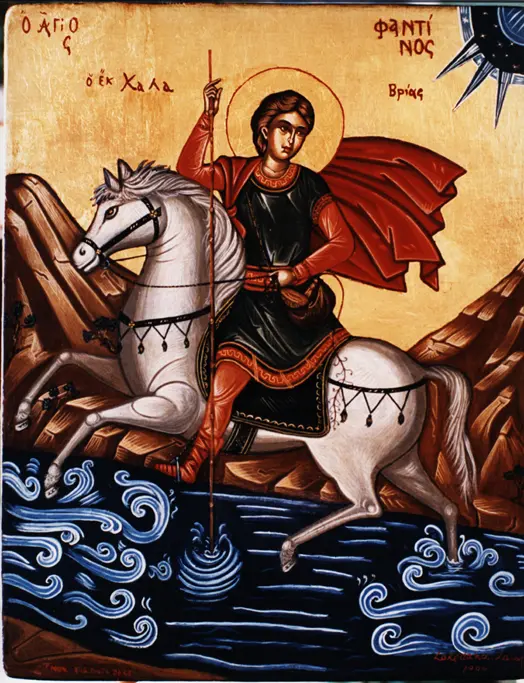
Byzantine icon of Saint Fantino «il Cavallaro» of Calabria on horseback touching the waters with his staff.
A Passage from His Life: The Miracle on the Metauro River
Among the best-known episodes in the bios of Saint Fantino is the miracle performed together with Saint Balsamio on the Metauro River (today's Petrace), also depicted on the cover of the Saint's Life: the river waters parted at the Saint's touch to allow a miraculous crossing.
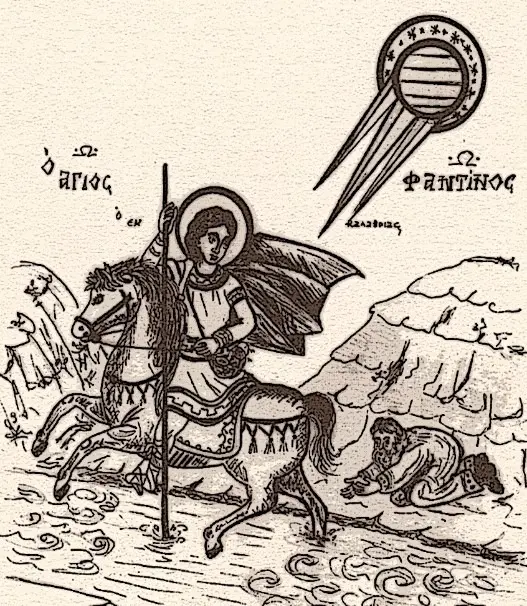
Saint Fantino and Saint Balsamio: the miracle on the Metauro River (engraving from the cover of the bios).
The Feast of July 24 and the Knights of Saint Fantino
The feast of Saint Fantino in Taureana falls on July 24 according to the Italo-Greek calendar. From 1994 to 2008 it preserved the original Byzantine tradition with the Divine Liturgy celebrated in Greek and orally transmitted Byzantine chants reintroduced in 1994 on the initiative of the San Fantino Cultural Movement.
Today the blessing of horses and the Knights of Saint Fantino remains, accompanied by the procession of the Saint's icon to the Crypt. His veneration endures across many towns in Sicily and Calabria, and even in Venice, where a church dedicated to him was built around the 9th century on the Island of San Marco opposite La Fenice theater — itself called «Teatro San Fantino» until the 18th century.
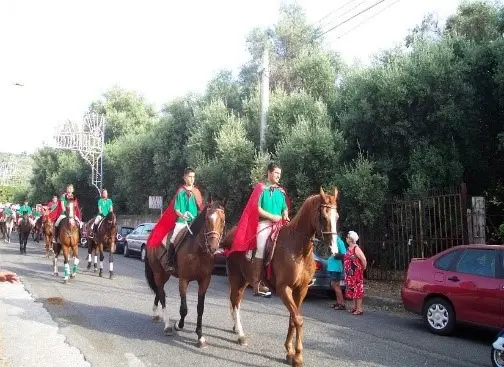
The Knights of Saint Fantino riding in red cloaks during the traditional July 24 feast in Taureana di Palmi.