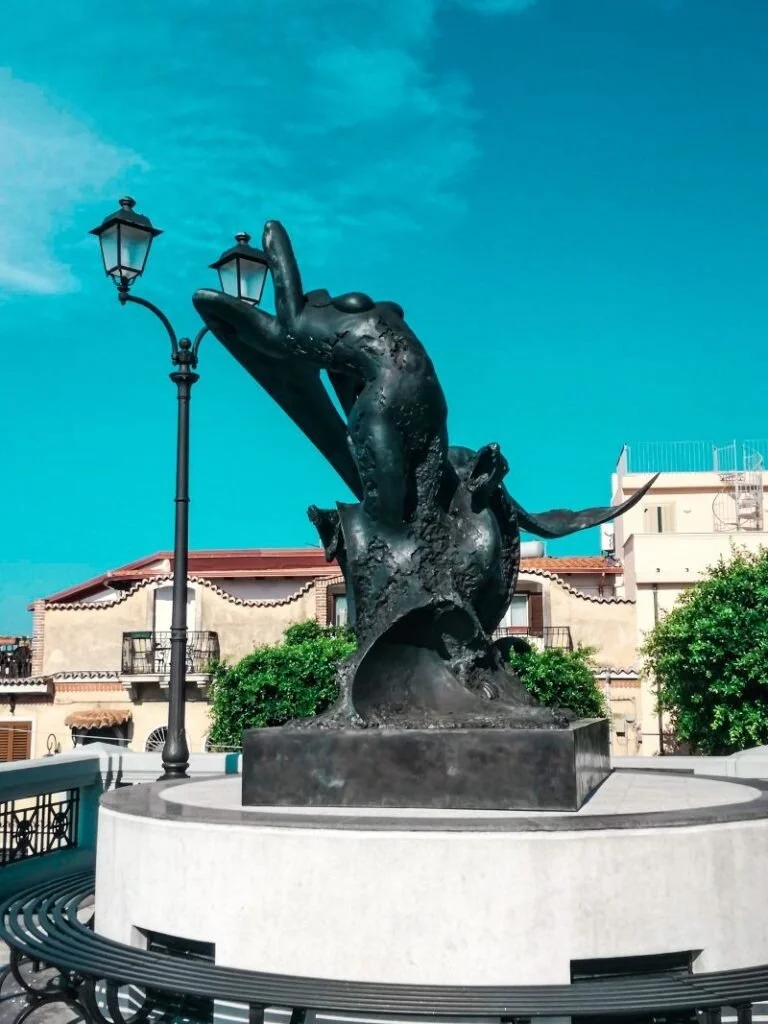
The Myth of Scylla and Charybdis: Between Homer, Virgil, and Strait Legends
According to the Odyssey, Scylla is the daughter of the goddess Crataeis. Discover the full myth of Scylla and Charybdis, verses by Virgil and Homer, and the philological theory behind their names.
1. The Origins of Scylla and Her Metamorphosis
Scylla (Ancient Greek Σκύλλα, Skýlla) is one of the most famous sea monsters of Greek mythology. In the most common account she is the daughter of Phorcys and Ceto, while the Odyssey calls her daughter of the goddess Crataeis; other traditions trace her birth to Phorbas and Hecate, Typhon and Echidna, or Zeus and Lamia.
Originally, Scylla was a blue-eyed sea nymph living in Calabria who loved bathing along the shore of Zancle. One evening she saw Glaucus, a former mortal fisherman transformed into a half-man, half-fish sea god, rising from the waves. Terrified by his appearance, she fled to the mountains. Heartbroken, Glaucus asked the sorceress Circe for a love potion, but Circe fell in love with him instead. Rejected, she took revenge by pouring a wicked brew into Scylla's bathing cove: six fierce dog heads sprouted from the nymph's waist and her legs turned into long serpent tails. Horrified by her reflection, she plunged into the sea and hid in a cavern facing Charybdis.
The rocky headland of Scilla on the Strait of Messina, home to the ancient myth of Scylla and Charybdis.
2. Scylla in Classical Literature: Homer, Ovid, and Virgil
Scylla appears across the greatest works of classical antiquity: Homer's Odyssey (Book XII), Ovid's Metamorphoses (Books XIII–XIV), and Virgil's Aeneid (Book III), where Aeneas is warned of the twin perils guarding the Strait:
> "On the right side waits Scylla; on the left, insatiable Charybdis, a vast abyss sucking the waves down three times a day and hurling them back toward the stars. Hidden within her dark cave, Scylla stretches out her jaws to seize passing ships—maiden above the waist, monstrous sea-beast below with dolphin tails and wolf-like bellies." (Virgil, Aeneid, III)
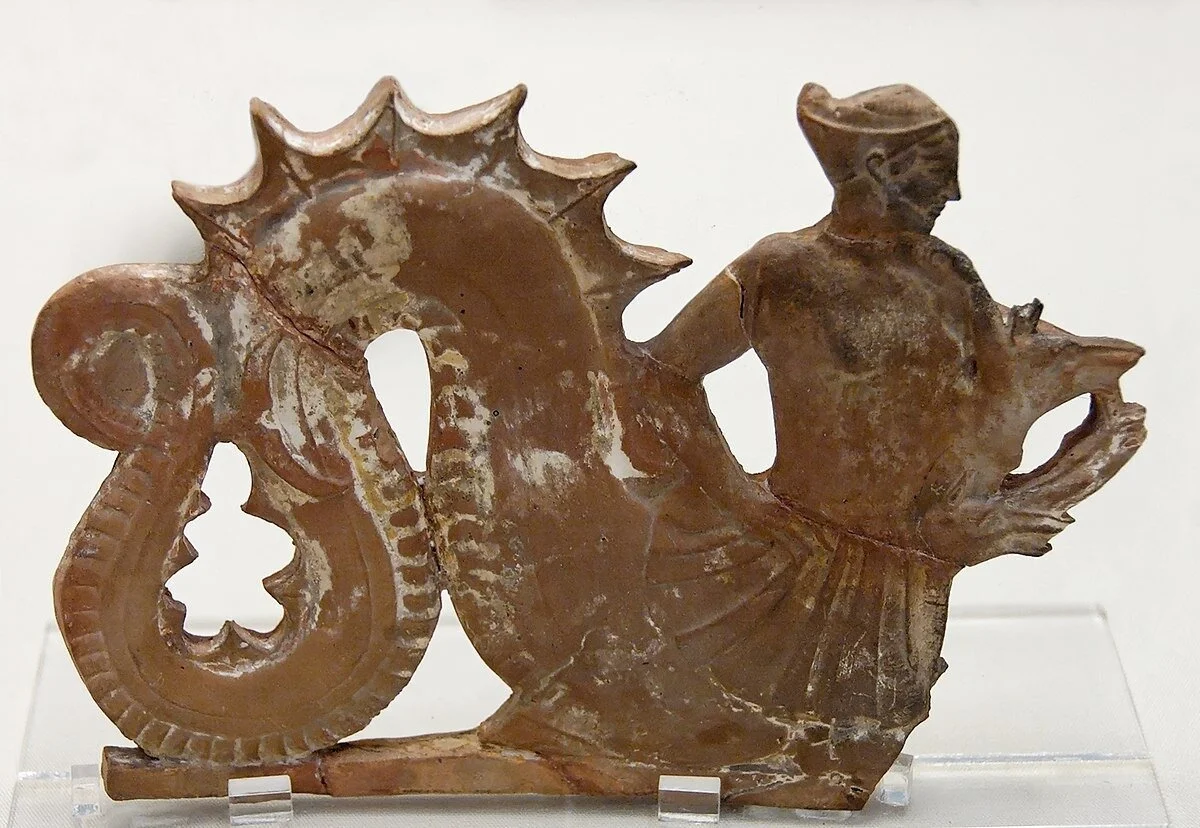
Classical depiction of the sea monster Scylla on ancient Greek pottery (Wikimedia Commons).
3. The Story of Charybdis and the Strait's Whirlpools
Charybdis was originally a voracious naiad, daughter of Poseidon and Gaia. After she stole and ate some of Geryon's cattle from Heracles, Zeus struck her with a thunderbolt and cast her into the sea, transforming her into a giant lamprey-like monster that swallowed and spat out huge volumes of water three times daily.
Positioned on the Sicilian side opposite Scylla's rock, she forced every passing vessel to skirt one of the two hazards. According to myth, the Argonauts survived the passage guided by Thetis, mother of Achilles. In the Odyssey, Odysseus chose to sail closer to Scylla, sacrificing six rowers rather than losing his entire ship to Charybdis's whirlpool—and later survived her maw by clinging to a wild fig tree above the cliff.
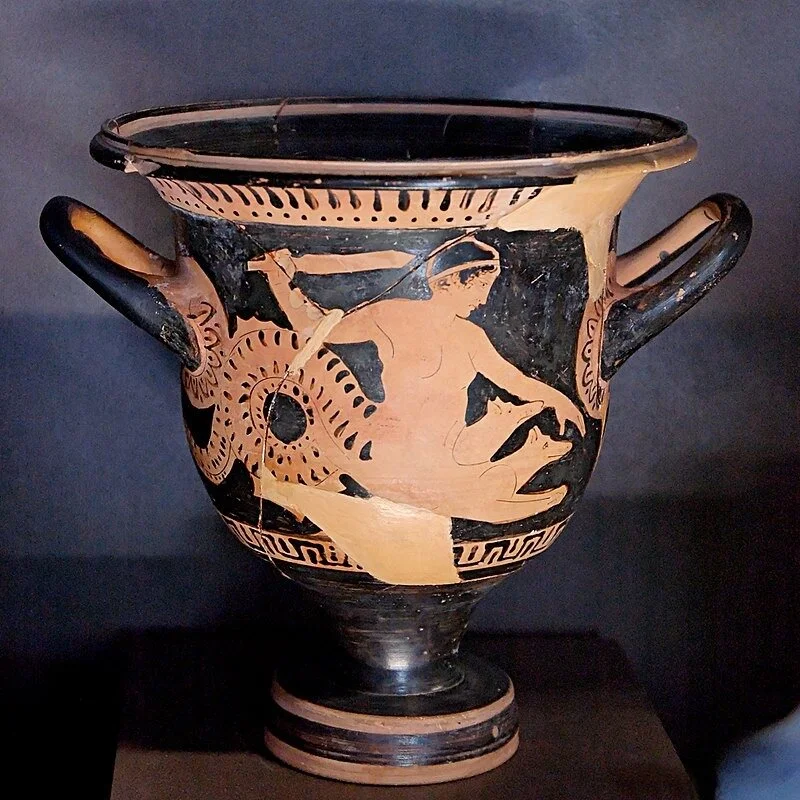
Ancient bell krater housed at the Louvre Museum depicting the myth of Scylla.
4. The Philological Hypothesis: Shrimps in the Strait
In antiquity, sailors' tales grew in the telling (fama crescit eundo), turning coastal hazards into terrifying legends. Even though the currents of the Strait of Messina are far milder than great oceanic capes, they could still challenge small ancient vessels before earthquakes reshaped the seabed.
From Homer came the proverb "Incidit in Scillam, cupiens evitare Charybdim" (out of the frying pan into the fire). Yet a fascinating philological theory notes that schille (σϰίλλαι) in Calabrian Greek and caridi (ϰαρίδες) in Sicilian Greek both meant shrimps (just as palinuri referred to lobsters off Cape Palinuro). Originally, being "between Scylla and Charybdis" may have meant that whichever shore you docked on, you would end up eating the same prized crustaceans—delicacies sought even by the Roman gourmet Apicius according to the Suda.
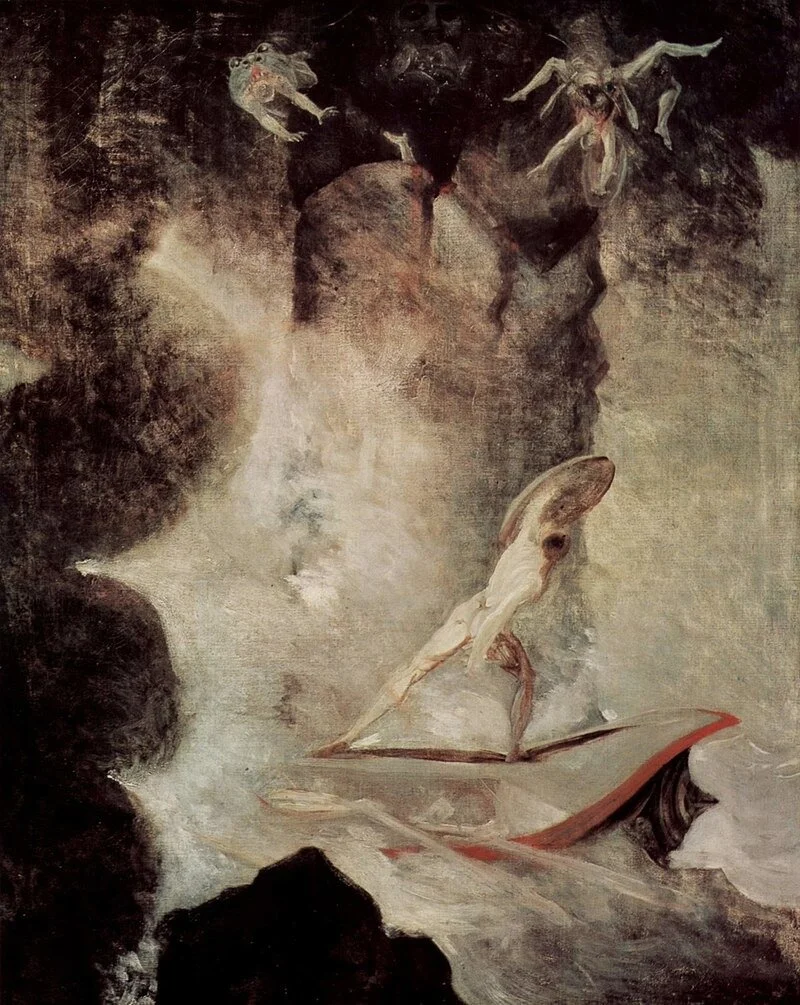
Scylla and Charybdis painted by Johann Heinrich Füssli (Public domain, Wikimedia Commons).
5. The Sirens, Scylla, and Charybdis in Odyssey Book XII
After leaving Circe's island and consulting Tiresias in the Underworld, Odysseus sails past the Sirens. Melting beeswax in the sun, he seals his companions' ears and has himself lashed to the mast so he can hear their enchanting song without leaping overboard.
Once past the Sirens, the ship enters the narrow Strait: on one side Charybdis churns the sea into boiling foam, exposing dark seabed sand; on the other, Scylla lunges from her cave and snatches six of Odysseus's strongest crewmen, lifting them up into the rocks like fish on a hook—the most pitiful sight Odysseus witnessed on his entire voyage.
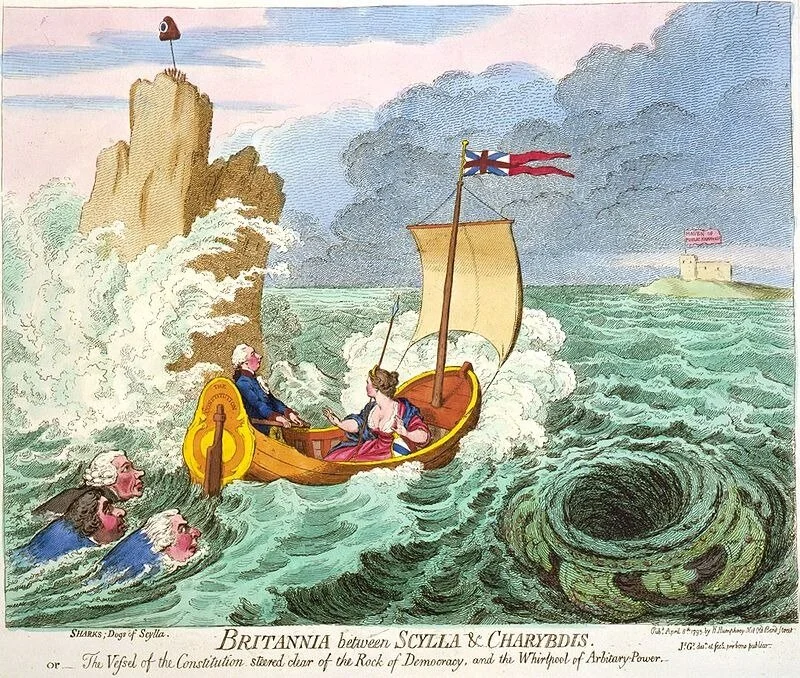
Scylla and Charybdis in a late 18th-century English satirical print by James Gillray (Library of Congress, Public domain).
6. Textual Notes and Mythic Glossary
- Sirens: in Greco-Roman myth, winged bird-women whose song lured sailors onto rocks (the fishtail image emerged in the Middle Ages).
- Calm (Bonaccia): dead calm at sea with no wind.
- Argives: inhabitants of Argos, used by Homer for all Greeks.
- Perimedes and Eurylochus: the two companions who tightened the ropes around Odysseus.
- Scylla and Charybdis: today their names endure on the real geography of the Strait, between Ruffo Castle's cliff in Calabria and Capo Peloro in Sicily.