What to See in Calabria: Monte Sant'Elia in Palmi, Balcony Overlooking the Tyrrhenian Sea
At 579 meters above Palmi, Monte Sant'Elia blends Saint Elias the Younger's monastic roots, the Three Crosses, the Tracciolino trail, and the Devil's Stone legend with sweeping views over the Tyrrhenian Sea and Aeolian Islands.
The 'Balcony Overlooking the Tyrrhenian Sea' and Saint Elias the Younger
Monte Sant'Elia rises in the municipality of Palmi and is known as the 'Balcony overlooking the Tyrrhenian Sea'. As a coastal ridge of the Aspromonte massif reaching 579 m, it is also one of Palmi's three official residential settlements.
Formerly called Aulinas or Salinas, it owes its spiritual legacy to the 9th-century Byzantine monk Saint Elias the Younger of Enna (born John of the noble Rachiti family), who founded the monastery of Le Saline, followed nearby on the Piani della Corona by the Imperial Monastery of the Corona, whose ruins were surveyed in 1991 by the archaeological cooperative C.A.S.T. of Bari.
As Leonida Repaci wrote: "Palmi has a God on its side, Monte Sant'Elia, from whose pine-covered summit one enjoys one of the most fascinating panoramas in the world."
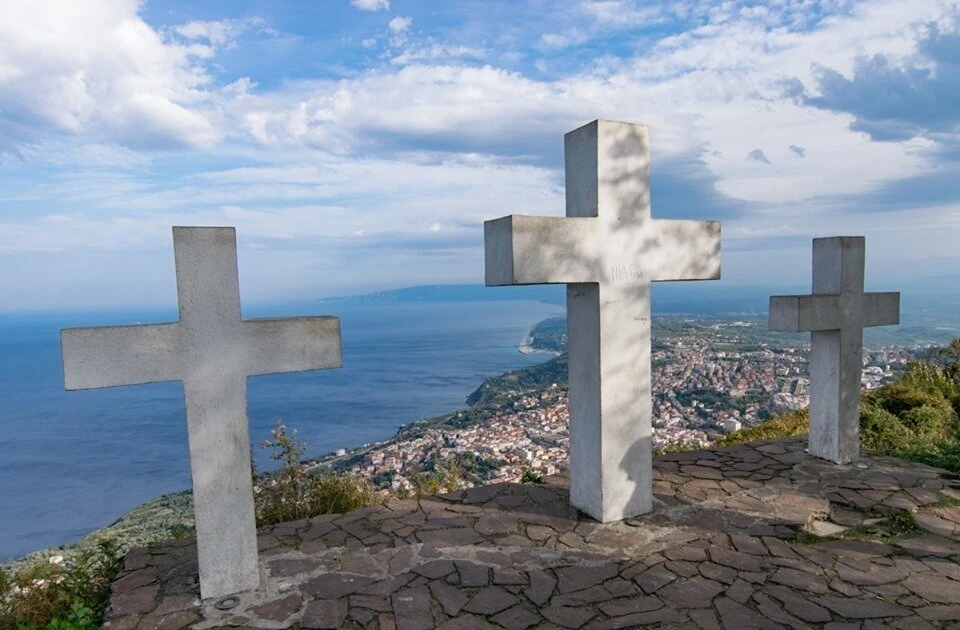
The Three Crosses on Monte Sant'Elia overlooking Palmi and the Gulf of Gioia Tauro.
Physical Geography and the Summit Three Crosses
Rising to 579 meters above sea level, Monte Sant'Elia marks the southern edge of the Plain of Gioia Tauro and descends dramatically in sheer cliffs along the Costa Viola, directly above Marinella Bay, Grotta delle Sirene, Grotta dell'Arcudace, Grotta Perciata, and Pietra Galera.
Covered in maritime pines and chestnut woods, the entire mountain falls within Calabria's regional protected Natura 2000 sites.
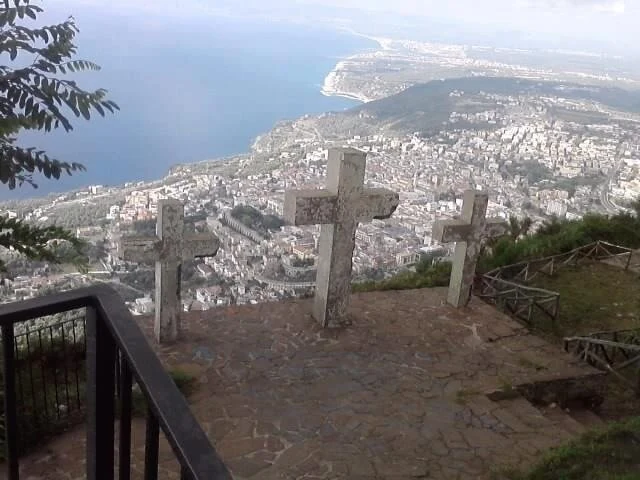
View of the 'Three Crosses' at the summit of Monte Sant'Elia.
Origins of the Name, Little Church, and Belvedere
Before the 10th century the peak was called Monte Salinas after the Byzantine Turma delle Saline. From 1657 a transcription error added the name Aulinas, before Saint Elias's 9th-century presence gave it its lasting name.
At the summit stands the Church of Saint Elias (1958) on a site occupied since 884 AD, alongside the Rocco Isola–Pelorosso belvedere looking out from Capo Vaticano to the Strait of Messina, the Aeolian Islands, and Mount Etna.
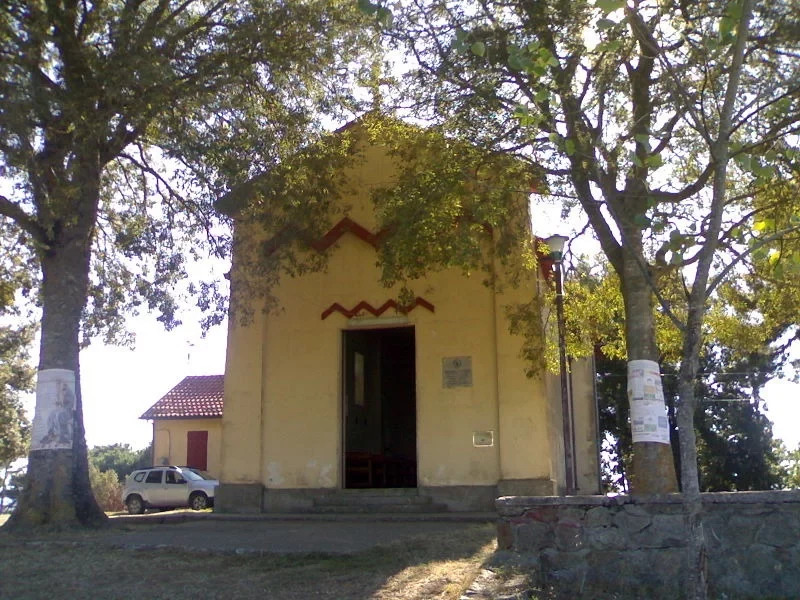
Little Church of Prophet Saint Elias at the summit of the mountain.
Natural Areas: The Tracciolino Trail, Flora, and Birds of Prey
Hiking routes center on the summit paths and the famous Sentiero del Tracciolino, clinging mid-slope above the Costa Viola cliffs.
Protected under SIC 'Costa Viola e Sant'Elia' and ZPS 'Costa Viola', the slopes feature historic terraced vineyards of Gaglioppo, Malvasia, and Zibibbo, cliff-dwelling Dianthus rupicola, holm oak woods, and a vital spring migration flyway for golden eagles, black kites, falcons, eagle owls, and Dartford warblers.
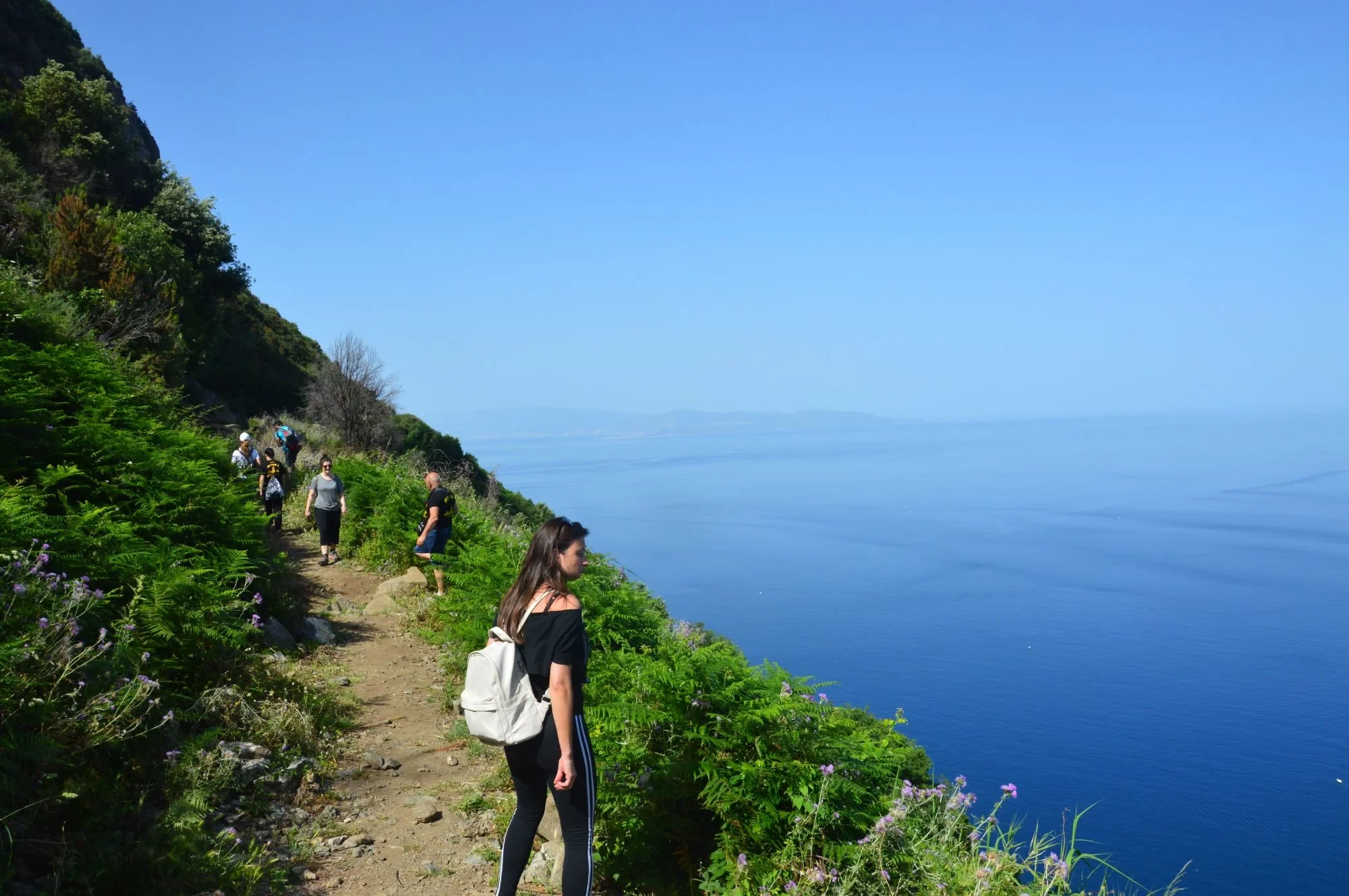
The Tracciolino Trail winding along the coastal cliffs of Monte Sant'Elia.
The Legend of the Devil's Stone
An ancient Calabrian-Sicilian legend recorded by philosopher Domenico Antonio Cardone and historian Antonio De Salvo (Palmi dal suo Sant'Elia, 1939) tells how Saint Elias defeated the devil tearing down his monastery at night, hurling him against the flat granite boulder known as Pietra del Diavolo (which still bears knee- and fist-like marks) and throwing his staff across the sea to Stromboli.
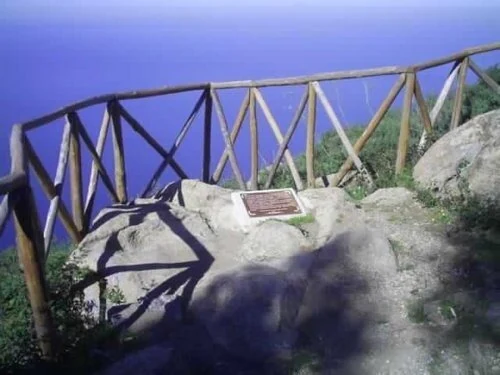
The Devil's Stone with its commemorative plaque at the summit of Monte Sant'Elia.
Religion, Traditions, and Torchlight Procession
Both Catholic and Orthodox traditions revere Saint Elias the Younger and Saint Philaretus (Roman Martyrology, April 6).
Annual celebrations include: - the Feast of Prophet Saint Elias on July 20; - the Feast of the Madonna della Montagna on September 8, culminating in a traditional torchlight procession.
Sources: Wikipedia – Monte Sant'Elia (Palmi) (CC BY-SA) and calabriadreamin.it.
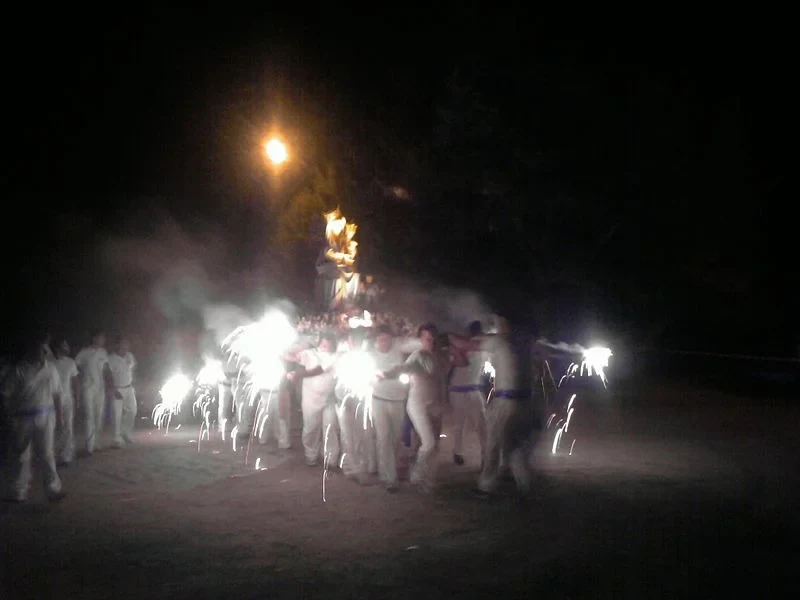
Torchlight return of the Madonna della Montagna procession on Monte Sant'Elia.
Overlooking Infinity 500 Meters Above the Sea
The stepped walkway leading out to the main panoramic railing remains one of Calabria's most iconic viewpoints, uniting on clear days the coastline of Palmi and Bagnara, the Strait of Messina, the Aeolian volcanic arc, and Mount Etna.
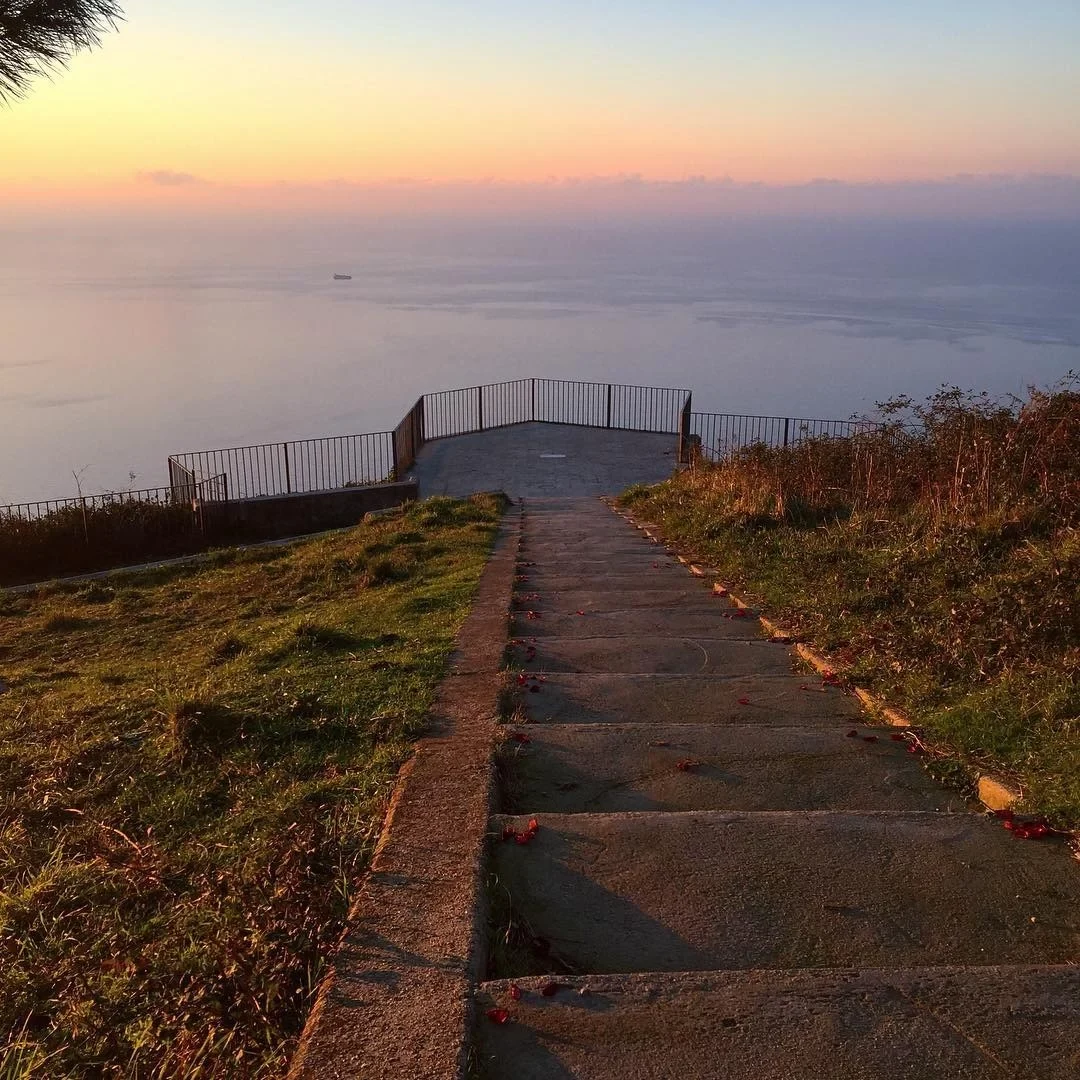
Monte Sant'Elia scenic terrace (photo by Gianluca Benigno).