The Tracciolino Trail on Calabria's Purple Coast: Complete Cliffside Trekking Guide
Complete trekking guide to the Tracciolino Trail between Palmi and Bagnara Calabra: 15 clifftop stages along the Purple Coast, Byzantine hermit caves, pristine coves, and Aeolian sunsets.
1. The Tracciolino from Above: The Map of the Balcony over the Purple Coast
Calabria preserves one of the most scenic coastal hiking trails in the Mediterranean: the Tracciolino Trail. Suspended between 400 and 430 meters above sea level along the granite cliffs of the Costa Viola (Purple Coast), this path carved directly into the rock connects Palmi with Bagnara Calabra, offering plunging views over the sapphire waters of the southern Tyrrhenian.
As Italian writer Luigi Parpagliolo famously observed: > «This route is defined as the last link in a chain stretching from the wild Apennine heights to mirror itself in the smiling waters of the Tyrrhenian; on one side it towers over a lush plain that resembles a gleaming sea, while on the other it gazes through the thousand eyes of its cliffs onto the boundless ocean below.»
Originally built as a hydraulic service path, the Tracciolino spans 9 to 11 kilometers, providing a front-row balcony overlooking the Strait of Messina, Mount Etna, and the Aeolian volcanic archipelago.
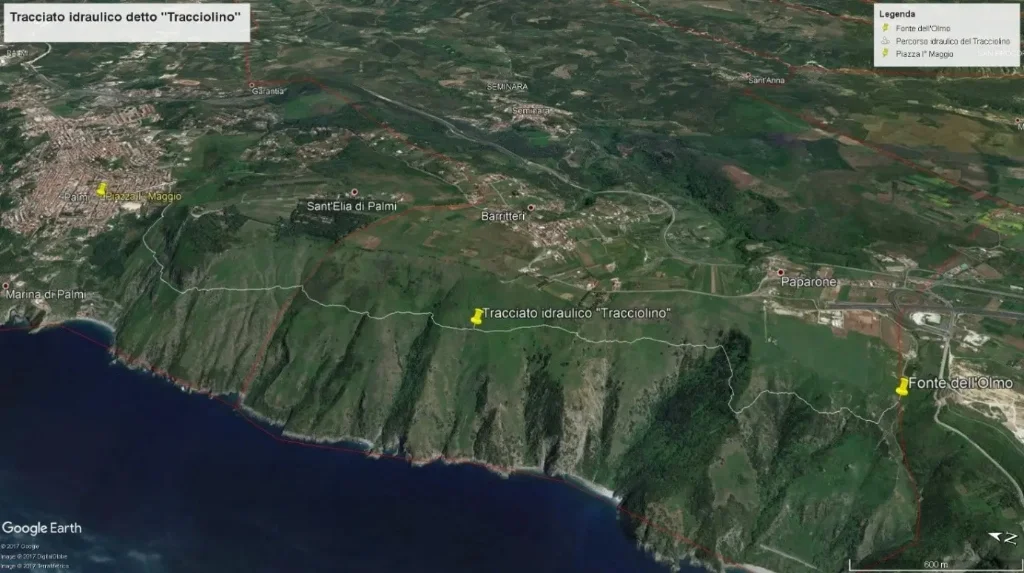
Satellite overview and topographical route of the Tracciolino cliffside trail on the Purple Coast
2. Saline Valley and the Spelaioti Hermits: Byzantine Legacy of San Fantino and Nicodemo
Hiking along the Tracciolino is an immersion into centuries of spiritual heritage. In 536 AD, Byzantine general Belisarius landed in Reggio, making Calabria a province of the Eastern Roman Empire. From Mount Pollino to the Aspromonte ridges, hermit monks known as Spelaioti settled in remote cliffside caves, dedicating their lives to vegetarian asceticism, contemplative prayer, and nocturnal vigil.
This Italo-Greek monastic movement expanded with Christian refugees fleeing the Arab conquest of Syria, Egypt, and Palestine in 636 AD, joined after 750 AD by monks fleeing Constantinople's iconoclastic persecutions and 9th-century refugees from Muslim Sicily.
Among the spiritual landmarks along this coast are the Coenobium of San Fantino in Taureana (Calabria's oldest Christian sanctuary), the cave of Sant'Elia Speleota in Melicuccà, and the Saline monastery founded by Saint Elias the Younger, alongside the revered memory of Saint Nicodemus of Cirò.
📍Locate the Ancient San Fantino Complex at Taureana on Google Maps
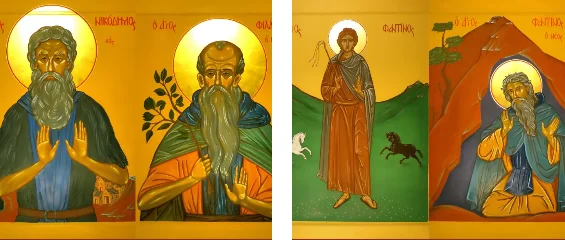
Sacred icons of Italo-Greek hermit fathers: San Fantino the Elder and San Nicodemo, symbols of Byzantine spirituality on the Purple Coast
3. Fiery Sunsets and the Aeolian Islands: The Chromatic Magic of Costa Viola
Tradition credits the Greek philosopher Plato with naming the Costa Viola (Purple Coast): sailing through these waters at dusk, he was struck by the violet reflections shimmering across the sea and dark coastal headlands. Along the Tracciolino, this optical wonder unfolds at every turn.
On clear afternoons, panoramic views sweep 180 degrees over the lower Tyrrhenian. The volcanic silhouettes of the Aeolian Islands emerge sharp on the horizon: Stromboli with its plume of smoke, Panarea, Lipari, Vulcano, Salina, and even distant Alicudi and Filicudi. Wild rosemary, myrtle, broom, and Mediterranean scrub infuse the air with seaside fragrances.
Ancient dry-stone terraced walls (armacìe) cascade down the dizzying slopes, where local farmers have cultivated sweet Zibibbo grapes for centuries.
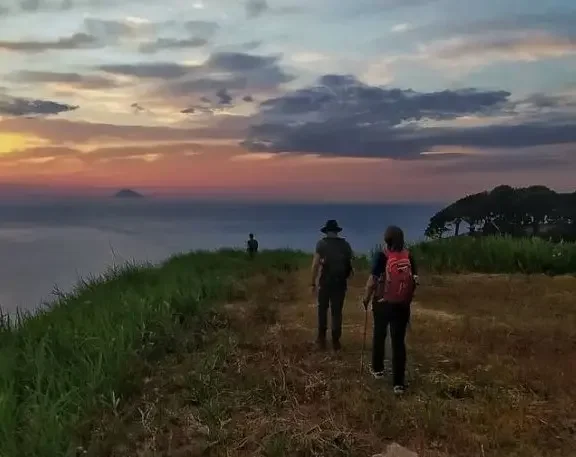
Evocative view of the Tracciolino Trail on the Purple Coast looking towards the Aeolian Islands at sunset (ph. @costan_tina)
4. Mount Sant'Elia and the Three Crosses: The Guardian Peak of Palmi
The upper trailhead begins near Monte Sant'Elia, rising 579 meters above sea level as Palmi's protective natural watchtower. The summit is crowned by the iconic Three Crosses, commemorating Calvary and serving as a focal point for historic pilgrimages.
Here, Saint Elias the Younger lived as an ascetic hermit, founding the Aulinas monastery in 884 AD. From the Three Crosses belvedere, hikers enjoy panoramic vistas spanning the Gioia Tauro plain, Capo Vaticano, and the sheer drop onto the Tracciolino ledge.
📍Visit Mount Sant'Elia and the Three Crosses Belvedere on Google Maps
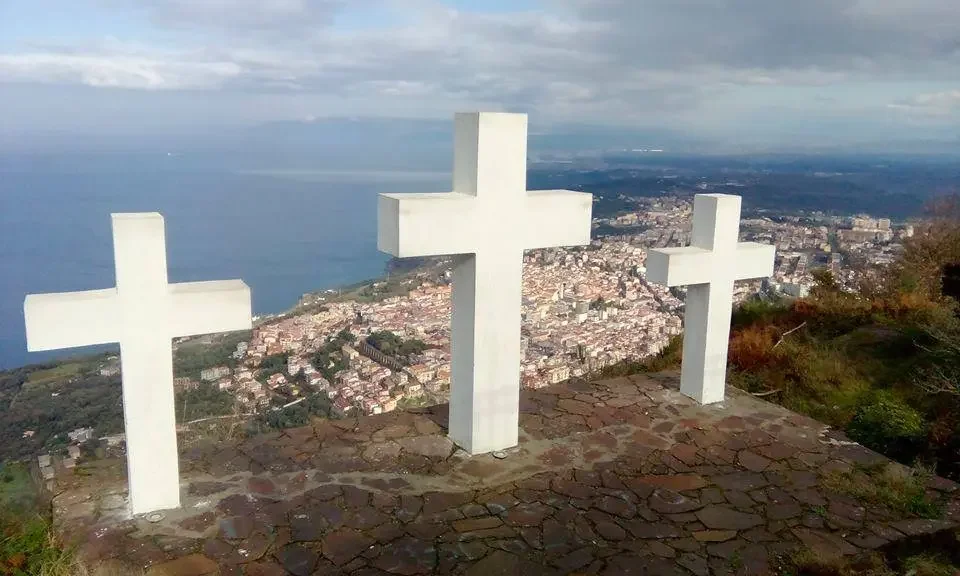
The Three Crosses of Mount Sant'Elia overlooking Palmi and the Tyrrhenian coastline toward the Strait
5. Balcony over the Tyrrhenian: Contrasting Currents and Sea Tones
Winding beneath the cliffs of Mount Sant'Elia at Acqua dei Cacciatori, the Tracciolino bends along natural contours to reveal the renowned Balcony over the Tyrrhenian, hovering 400 meters above the surf.
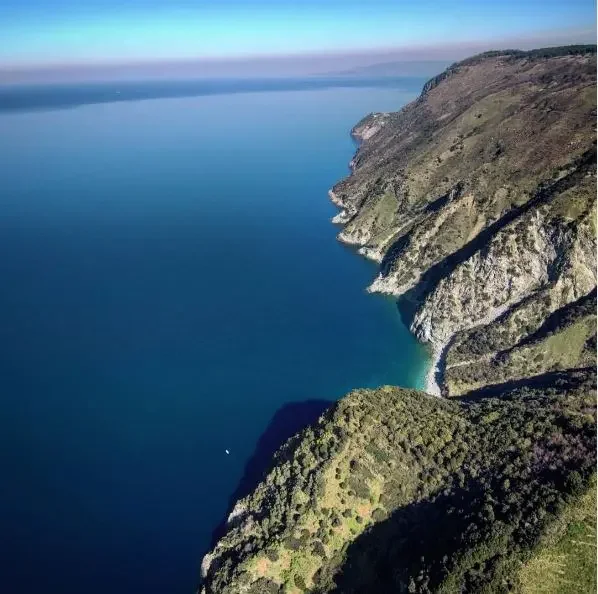
From here, observers can watch the oceanographic meeting of the Tyrrhenian Sea and the Ionian waters flowing through the Strait of Messina. Distinct current lines create visible color contrasts, shifting from deep navy blue offshore to brilliant turquoise and translucent emerald near the cliffs.
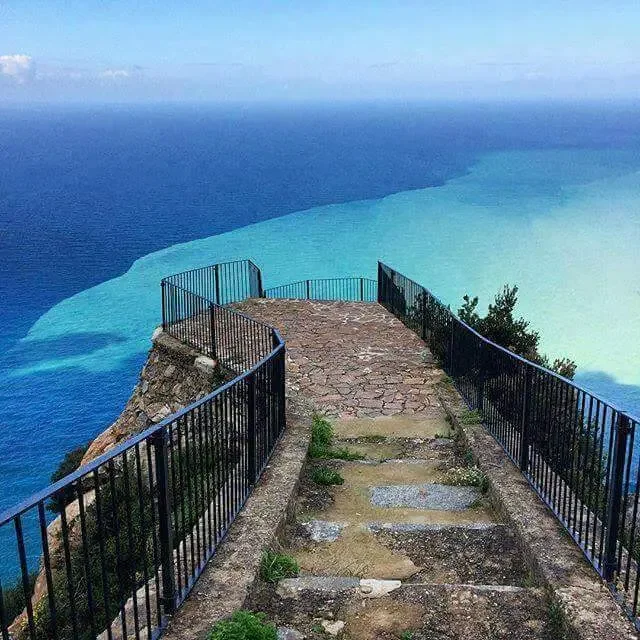
Sheer clifftop panorama from Mount Sant'Elia displaying the striking color variations of the coastal waters
6. Marinella di Palmi: The Pebble Cove Nestled in the Cliffs
Looking down from the first stretch of the trail, the pristine bay of Marinella di Palmi reveals itself. This crescent cove of smooth white pebbles is framed by rocky bluffs blanketed in evergreen maquis and washed by exceptionally clear waters.
Accessible from sea or via a steep cliffside staircase from above, Marinella's deep seabeds make it a paradise for snorkeling and scuba diving, shielded from winds by massive promontories.
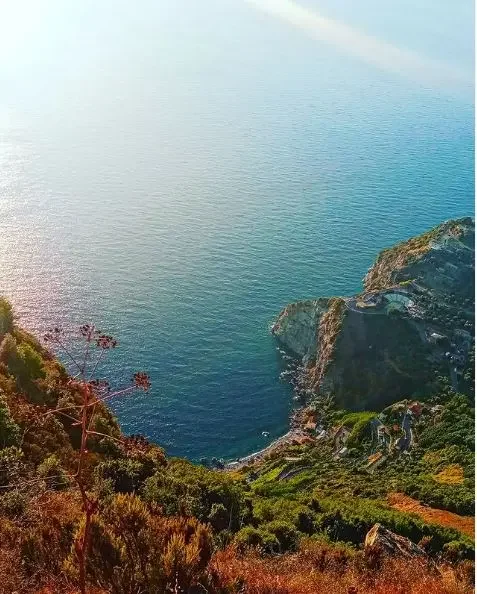
The bay and pebble cove of Marinella di Palmi viewed from high above on the Tracciolino Trail (ph. @antohippy80)
7. Caletta Sorrentino: The Pastry Chef's Dream and the Restored Hermitage
Tucked away near Punta Surrintinu and the legendary Rovaglioso Cove (where myth says Orestes was cured of madness), lies the secluded Caletta Sorrentino.
A remarkable contemporary account recorded by historian Domenico Minuto in 2002 tells of an extraordinary event: Saint Elias the Hermit appeared in a dream to a master pastry chef from Bagnara Calabra, urging him to restore a long-lost coastal chapel on the boundary of Melicuccà's monastic grounds.
Guided solely by the dream, the pastry chef took a boat along the rugged cliffs between Bagnara and Palmi. He found the ancient ruins in the exact historical location and rebuilt the hermitage with his own hands, placing a modest wooden sign above the altar: > «We accept offerings of prayers, not of money.»
📍Explore the Rovaglioso and Punta Sorrentino area on Google Maps
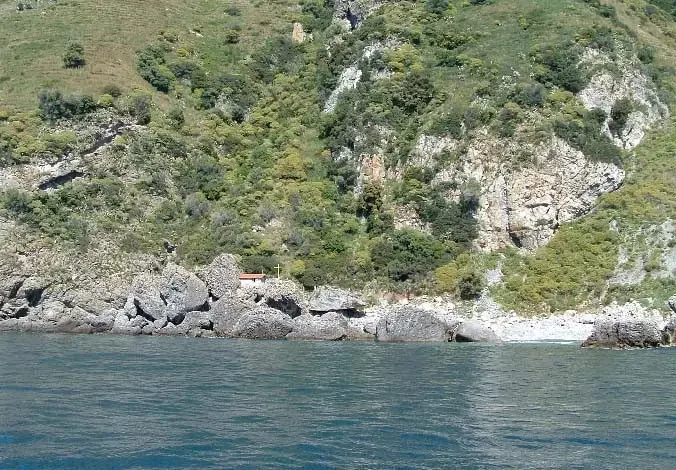
Caletta Sorrentino and the isolated clifftop hermitage rebuilt by the devoted pastry chef from Bagnara Calabra
8. The Olmo Aqueduct: A 17th-Century Hydraulic Engineering Marvel
The existence of the Tracciolino Trail stems from one of Southern Italy's boldest hydraulic achievements. In 1669, Marquis Andrea Concublet, feudal ruler of Arena and re-builder of modern Palmi, commissioned a municipal water conduit.
To channel spring water from the high-altitude Sorgente dell'Olmo springs (near Bagnara) all the way to the Fontana della Palma in Palmi's central square, master stonecutters carved an 8.5-kilometer gravity-fed aqueduct into sheer granite cliffs.
Hikers today walk directly atop the stone conduit cover, passing historic decantation wells, cisterns, and water channels engineered with precise hydraulic incline over 350 years ago.
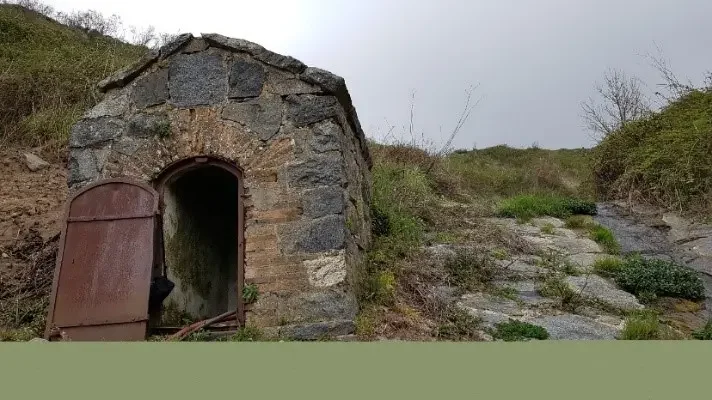
The 17th-century Olmo Aqueduct, a masterpiece of hand-cut hydraulic engineering carved into the cliff face
9. San Sebastiano Coast: Monk's Cave and Saint Leo's Cave
The central section between Seminara and Bagnara forms the historic San Sebastiano Coast. In earlier centuries when sea levels were lower, natural caves were easily reached on foot, providing sanctuary for Byzantine ascetics and local villagers escaping corsair fleets.
Grotta del Monaco (The Monk's Cave) derives its name from a striking white calcite vein contrasting against dark basalt rock, resembling a bearded monk kneeling in prayer with an open liturgical book. Prior to World War I, an 8-meter sandbank allowed local boaters to picnic inside.
Nearby lies Grotta di San Leone (often nicknamed the Swallow's Cave), celebrated for emerald reflections cast across cavern ceilings and home to a protected bat sanctuary.
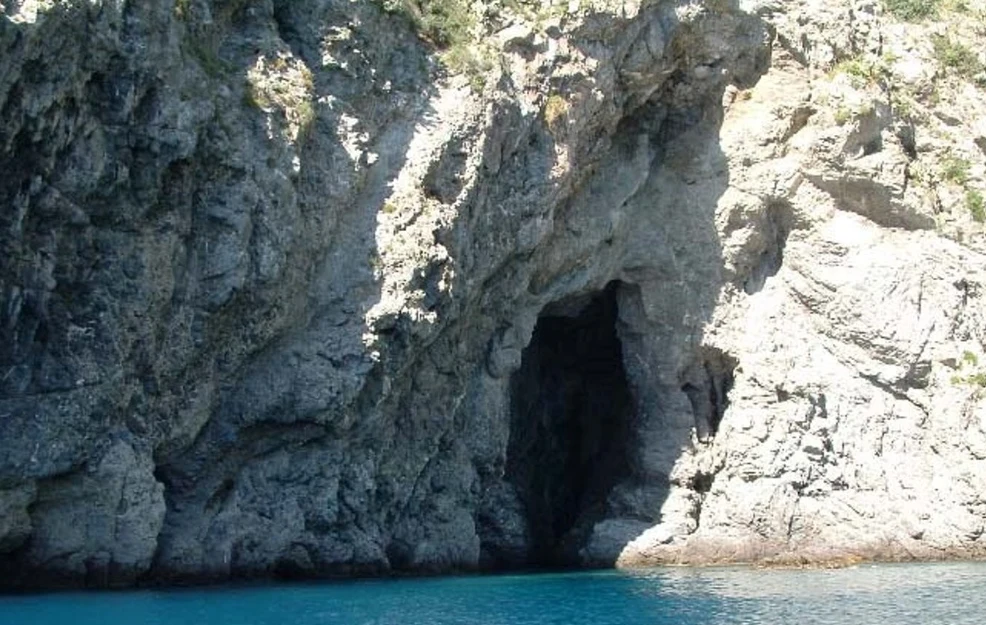
The monumental Saint Leo Cave (Grotta di San Leone) carved into the cliffs along the San Sebastiano coastline
10. Cala Leone: Between Byzantine Emperor Leo VI and Pope Leo II
Surrounded by two immense rock buttresses, Cala Leone forms a pristine natural amphitheater of white pebbles and translucent azure depths.
Two intriguing historical traditions explain its name: 1. Byzantine Emperor Leo VI the Wise: Chroniclers recount that Emperor Leo VI, healed by the intercession of Saint Elias the Younger, sent imperial envoys to build a dedicated coastal monastery in this cove. 2. Pope Leo II: Other scholars argue the grotto served as an ascetic hermitage for young Leo Meneio, a Reggio Calabria native who became Pope Leo II in 682 AD, known for introducing the blessing with holy water and the liturgical greeting «Pax vobiscum».
The pristine, secluded cove of Cala Leone sheltered by towering coastal bluffs
11. Coastal Canyon: Twin Views of Cala Janculla and Cala Leone
Reaching an elevated vantage point on Barritteri's outer ridge, hikers encounter a twin perspective: to the left lies the wild chasm of Cala Janculla, while Cala Leone opens to the right.
This stretch illustrates the extreme topography of the Aspromonte massif plunging directly into the sea without coastal plains. The Tracciolino path navigates this edge, revealing dry-stone gullies that channel seasonal streams into hidden sandy coves below.
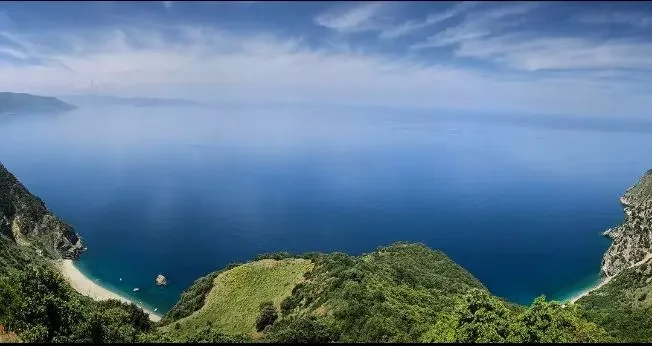
Spectacular cliffside vista embracing Cala Janculla on the left and Cala Leone on the right (ph. @associazionecrescerecca)
12. Cala Janculla (Kavajankuja): Amazon Myth, White Sands, and Blue Flags
Cala Janculla is considered the wild crown jewel of the Purple Coast. Named among Italy's top 10 beaches by Legambiente with 2 Blue Flags, it is protected under EU Natura 2000 as a Special Protection Area (SPA).
Its name originates from ancient Ionic-Doric roots: Kavajankuja («here she walks with she», symbolizing women united together) or Cava Janculla («pagan woman»). Classical myth recounts that a tribe of Amazons, descendants of Queen Sinope migrating from the Black Sea, settled along these beaches before establishing inland colonies near Sinopoli.
The cove boasts powdery white sand, a dramatic natural rock arch, and deep seabeds dropping past 20 meters, producing vivid violet and cobalt highlights.
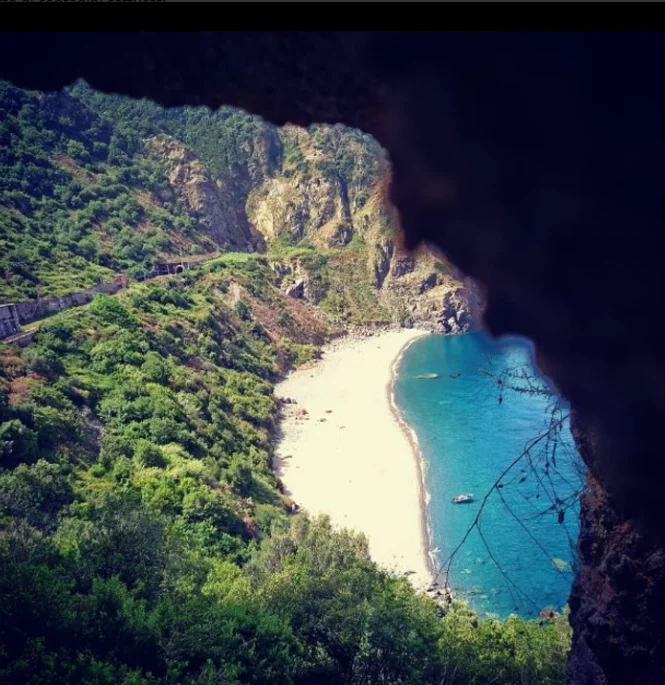
The natural rock arch and pristine white beach of Cala Janculla (ph. @trovatoaspromonte / @marimazzaa)
13. Petra Galera: The Prison Rock and Saracen Corsair Raids
A prominent historical landmark is the prison rock known as Petra Galera (Pietra Galera), a dark sea stack rising off Palmi's Marinella beach, mirrored by a similar stack 50 meters off Cala Janculla.
While folklore claims Amazons used the isolated rock to detain male captives, verified history between the 7th and 16th centuries saw these sea stacks serve as makeshift prisons for Saracen pirates.
Corsairs raiding inland farmland trapped captured peasants on the rock: unable to swim, captives could not escape the surrounding deep currents while pirates pillaged surrounding settlements up to Melicuccà. During these volatile centuries, Saint Elias the Younger himself remained confined in his mountain monastery atop Mount Sant'Elia due to pirate threats.
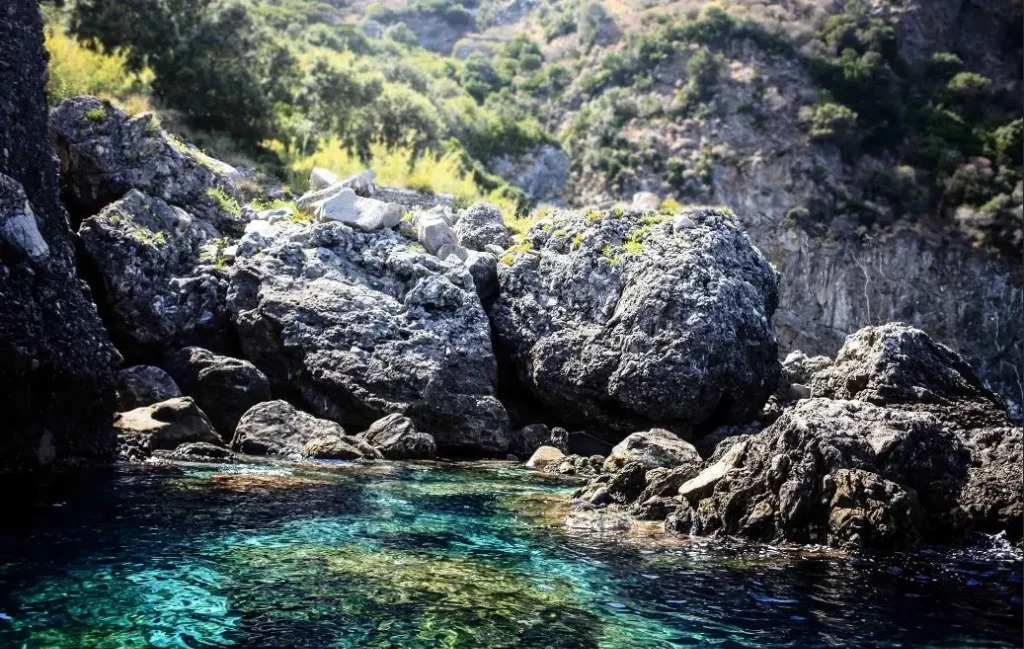
The imposing sea stack of Petra Galera at Marinella di Palmi, relic of centuries of corsair raids (ph. Giuseppe Barone)
14. Towards Ceramida: Madonna della Neve Plateau and the Bagnarote Women
Beyond the Olmo valley, the Tracciolino traverses southward at 400-430 meters altitude beneath the Madonna della Neve Plateau, a historic site of clashes during the Napoleonic French occupation (1806-1815).
These vertiginous cliffs were cultivated with heroic terraced vineyards (rasole). The unsung heroes of this agriculture were the Bagnarote—strong women of Bagnara Calabra who carried massive wicker baskets of harvested Zibibbo grapes (palamatare) on their heads up steep ravines to ox carts waiting on the main road.
Approaching Ceramida, panoramic views reveal Bagnara's harbor, Ruffo Castle, Scilla, and the Sicilian coastline across the Strait.
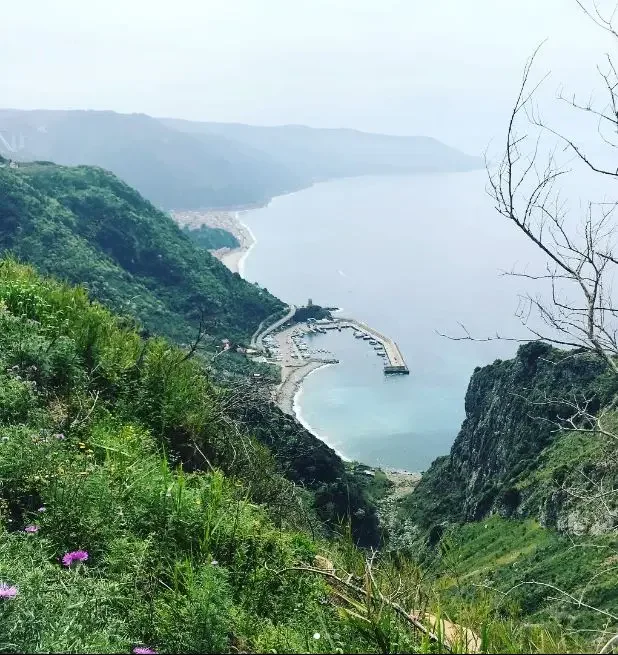
Breathtaking panorama from Ceramida overlooking the Strait of Messina and Bagnara harbor (ph. @antonino.sgro)
15. Arrival in Bagnara Calabra: Ruffo Palace and Complete Trekking Guide
The route reaches its finale descending toward Bagnara Calabra, renowned for swordfish fishing with traditional feluche boats, artisanal PGI torrone nougat, and historic Palazzo Ruffo perched over the sea.
### 🥾 Tracciolino Trail Technical Overview * Trailhead: Palmi (Piazza Primo Maggio or Monte Sant'Elia trailhead). * Endpoint: Ceramida / Bagnara Calabra. * Distance: ~9.2 km (one-way classic route) or 14 km (complete circuit). * Elevation: +280 m / -350 m (average elevation ~400 m). * Duration: 3.5 to 4.5 hours at a steady trekking pace with photography stops. * Difficulty: Moderate (E) with exposed cliff sections (EE) demanding surefootedness.
### 🎒 Essential Equipment and Safety Tips * Footwear: Ankle-support trekking boots with deep-tread Vibram soles are mandatory. * Sun Protection: The trail is westward-facing with minimal shade. Bring sunglasses, wide-brim hat, and high SPF sunscreen. * Water Supply: Carry at least 2.5 liters of drinking water per person; there are no active public fountains along the clifftop. * Logistics: Hikers completing the linear route from Palmi to Bagnara can return to their starting point in 7 minutes via frequent regional trains connecting Bagnara and Palmi railway stations.
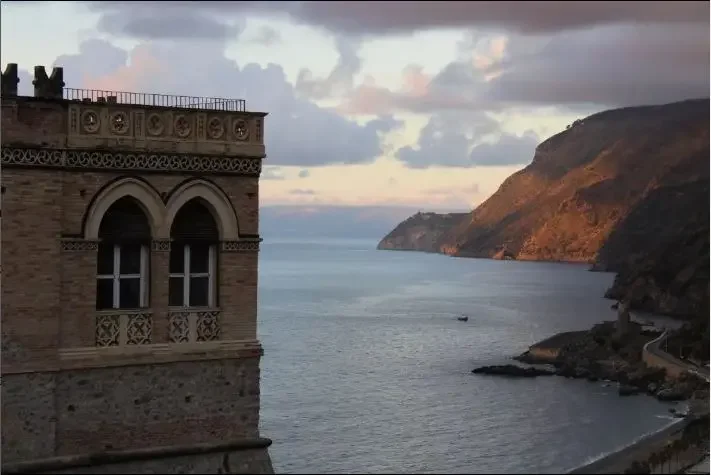
Sunset over Bagnara Calabra and the towering headland of the Purple Coast at the trail's conclusion