Ruffo Castle of Scilla: History, Architecture, and Lighthouse over the Strait
Ruffo Castle in Scilla is an ancient fortification standing on the Scilla promontory overlooking the Strait of Messina. Explore its history from Anaxilas to the Ruffo family, its architecture, and its lighthouse.
1. Ruffo Castle of Scilla: Genius Loci over the Strait
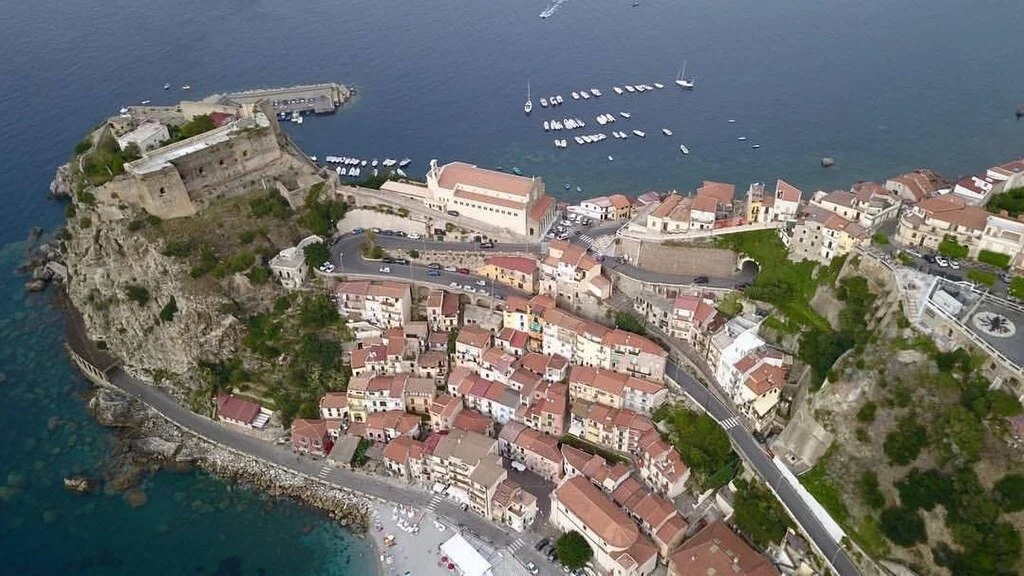
Ruffo Castle of Scilla, sometimes known as Ruffo Castle of Calabria, is an ancient fortification set on the Scilla promontory jutting into the Strait of Messina. Located roughly 20 km north of Reggio Calabria, it serves as the genius loci of Scilla and one of the most iconic landmarks of the Strait landscape. The fortress also houses an active Italian Navy lighthouse, the Scilla Lighthouse.
Aerial view of Ruffo Castle in Scilla (José Anacleto Treto Rosal, CC BY-SA 4.0, Wikimedia Commons).
2. Magna Graecia and Roman Era: From Anaxilas to Strabo
The earliest fortification of the Scilla cliff dates to 493 BC, when the tyrant of Rhegion Anaxilas the Younger fortified the rock to stop Tyrrhenian pirate raids, turning it into a naval outpost paired with a fortified harbor toward Punta Pacì. Rhegian rule was interrupted only between 390 and 340 BC by Dionysius of Syracuse until Timoleon of Corinth restored independence.
In the 3rd century BC the fortress held firm against the Carthaginians and Bruttians, and later Octavian strengthened it further—Pliny the Elder mentions Scilla as Oppidum Scyllaeum (Naturalis historia, III, 76). As the Greek geographer Strabo wrote of Skyllaion:
> "After the river Metaurus comes another Metaurus; then follows the lofty promontory of Skyllaion, forming a peninsula with a small isthmus accessible from both sides. Anaxilas, tyrant of Rhegion, fortified it against the Tyrrhenians as a naval station, preventing pirates from crossing the Strait." (Strabo, Geography, VI, 1, 5)
3. The Middle Ages and the Ruffo Lordship
Excavations have uncovered walls of the Basilian monastery of San Pancrazio, built in the mid-9th century as a defense against Saracen raids. In 1060, during the Norman siege of Reggio by Roger and Robert Guiscard, the fortress resisted at length and surrendered only to starvation.
Fortified by Pietro Ruffo in 1255 for Manfred and later by Charles I of Anjou, the castle was granted in 1469 by King Ferdinand I of Naples to Castilian knight Gutierre De Nava, before being acquired in 1543 by Paolo Ruffo. He restored the baronial palace shortly before the Ruffo family received the title of Prince in 1578. Their noble coat of arms and 16th-century commemorative plaque remain proudly visible.
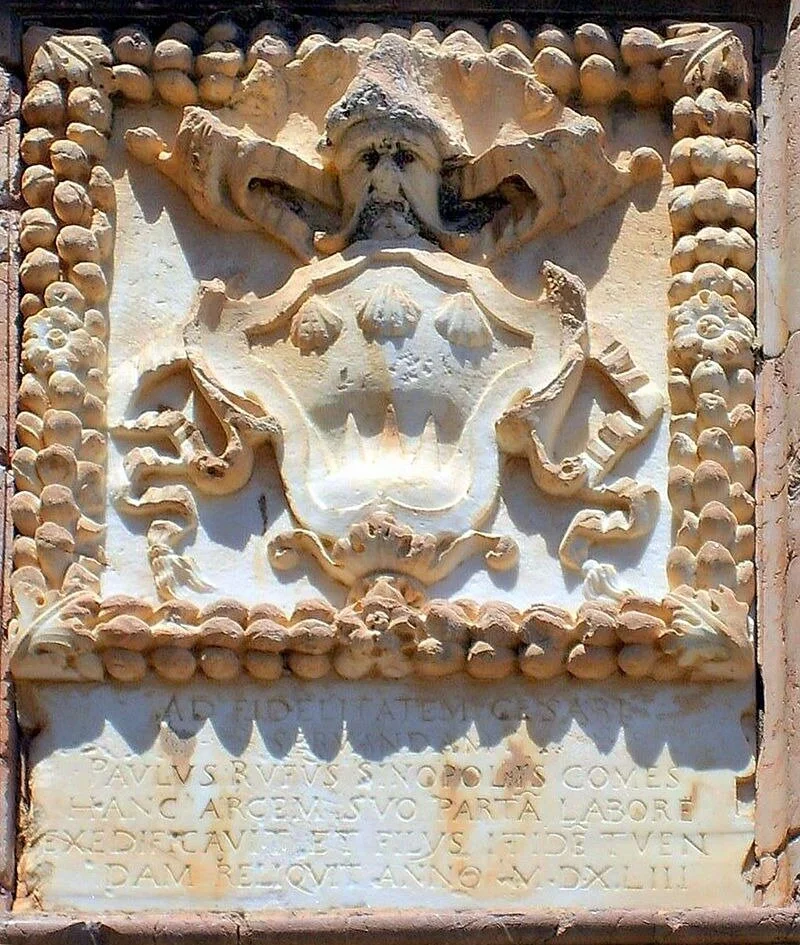
The Ruffo family coat of arms and the 16th-century restoration plaque (Public domain, Wikimedia Commons).
4. Modern Era, Earthquakes, and Fortress Architecture
Severely damaged by the 1783 earthquake, the castle became state property in 1808 and was restored in 1810. Hit again by the 1908 quake, later split into apartments for civil servants during the Fascist era, and subsequently used as a youth hostel, it has now been thoroughly restored as a cultural center hosting the Regional Center for the Recovery of Calabrian Historic Centers, exhibitions, and conferences.
Standing on the headland dividing Marina Grande and Chianalea, the fortress features an irregular yet cohesive layout with curtain walls, towers, and loopholes. A bridge leads to a pointed-arch stone portal, beyond which a vaulted passage opens onto a courtyard and grand staircase leading to the spacious baronial halls.
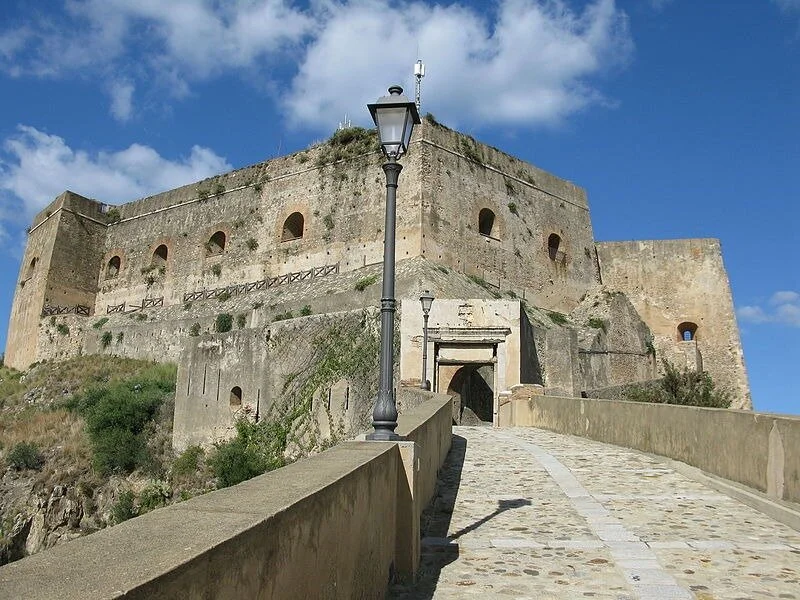
The fortress walls of Ruffo Castle overlooking the Tyrrhenian Sea (Jacopo Werther, CC BY-SA 4.0, Wikimedia Commons).
5. The Scilla Lighthouse
Taking advantage of the castle's commanding position over the Strait of Messina, a lighthouse was built on its highest terrace in 1913 to guide passing ships. The Scilla Lighthouse—a distinctive white cylindrical tower standing 6 meters tall on a black base—remains active today under the management of the Italian Navy.
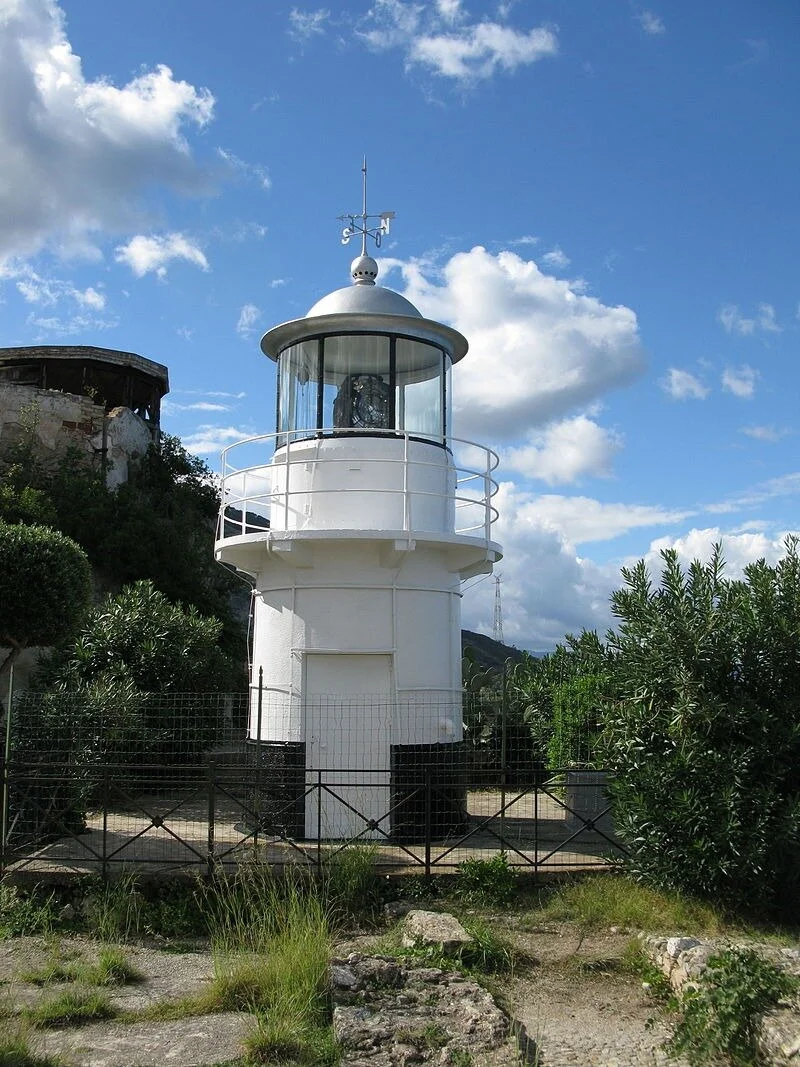
The Scilla Lighthouse atop Ruffo Castle (Wikimedia Commons).